
This week
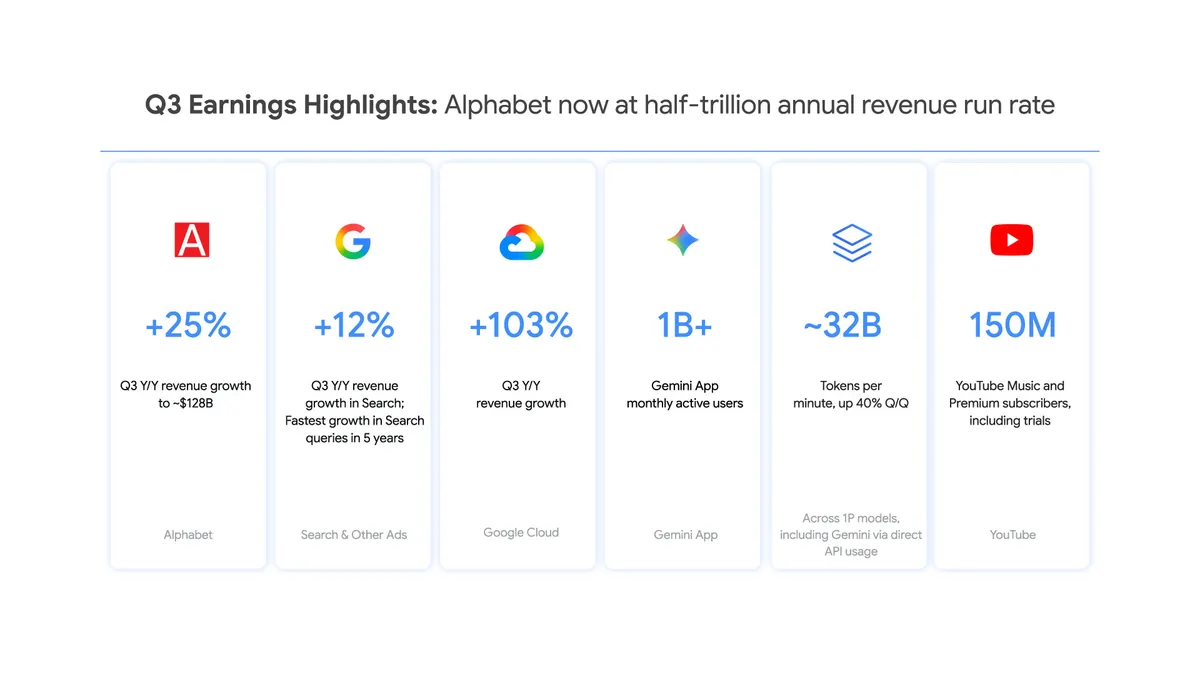
Google had an uncomfortable reminder this week that being good at AI and making money from it are different achievements. Revenue rose 25% and cloud revenue more than doubled. The shares still fell 12.6% in a day.
Anthropic, meanwhile, filed to go public, and its prospectus gives a much clearer view of the business behind Claude. Apple’s new folding iPhone barely made it through its first weekend before the company was offering replacements for faulty screens.
All three are about what happens once the demonstration is over. Further down: AI shopping, creative tools and a new way to explore customer reactions.
All this and more in your weekly cut of marketing AI news.
Key stories
Google’s shares plunge as the AI search business gets harder to price
What’s the story?
Alphabet’s Class A shares fell 12.64% on Thursday 29 October, closing at $283.82 after Wednesday’s results. This was a sell-off after substantial growth: quarterly revenue rose 25% to $127.6 billion, and Google Cloud revenue grew 103%.
The trouble was the combination of an advertising miss and an enormous investment bill. Reuters reported advertising revenue below expectations, with the shift towards AI Mode weighing on monetisation. Capital expenditure reached $51.4 billion; free cash flow was negative $9.1 billion.
Google is already moving to close that gap. On 28 October it announced AI Mode ads in 10 more countries, including Australia, Canada and India, with the UK planned for later in the quarter. It is also introducing ads within follow-up conversations in the US.
Why it matters
AI search has a commercial tension built into it. Google wants to give people a better answer, often without making them visit another website. It also needs businesses to pay to reach those same people. As Sundar Pichai put it on the earnings call, the company is prioritising the experience, followed by monetisation.
A follow-up conversation is a different advertising opportunity from a single query. One that starts broad picks up the person’s budget, preferences and practical constraints as it goes. Each turn makes the placement more useful. It also gives Google more influence over which brands make the shortlist.
Our take
I’m watching the expansion of those ads more closely than any prediction that search is finished. Google has a strong incentive to make the new experience work for advertisers. What I don’t know yet is how much value reaches the advertiser once Google has taken its share.
Google says sponsored and organic product listings in AI Mode already get similar click-through rates. That is an early signal. Judge the first trials, in any market, on the commercial result: incremental customers, the ones who would otherwise have gone elsewhere.
Anthropic’s IPO filing reveals how big the business behind Claude has become

What’s the story?
Anthropic filed for a proposed initial public offering on 26 October. It intends to list on Nasdaq as ANT; an offer price and number of shares have yet to be set.
The prospectus shows revenue of $16.3 billion in the first half of 2026, up from $1.2 billion a year earlier. The operating loss narrowed to $693 million.
The $80.7 billion net loss needs explaining before it escapes into a headline. It includes a $72.4 billion fair-value charge on convertible notes and related instruments, largely driven by Anthropic’s rising valuation. It does not mean the company burned $80.7 billion in cash.
About $13.1 billion came from consumption-based revenue, against $3.2 billion from subscriptions. The business extends well beyond people paying for a Claude chat window.
Why it matters
An IPO would make one of the central companies in AI answer regularly to public investors. They will still ask which model is best. Now they will also ask, in public, what it costs to provide and what customers will pay for it.
The consumption-based business is the part that touches marketing. When an application runs on Claude behind the scenes, every call to the model is part of the cost of delivering the service. An assistant that does more work uses more computing, so a good product has to make that extra work worth paying for.
Our take
Anthropic’s $16.3 billion of first-half revenue makes AI demand harder to dismiss as hype, and “AI is a bubble” too broad to be useful. Investors can still pay too much for the shares of a company growing this fast. Google’s week shows how differently the market can judge growth and its economics: revenue up 25%, free cash flow negative $9.1 billion and the shares down 12.6% in a day.
I want buyers to judge the AI companies, more and more, on dependable work that customers keep paying for. This filing shows far more of the business behind tools many teams now rely on.
Apple’s iPhone Duo has a difficult first week in customers’ hands

What’s the story?
Apple’s folding iPhone Duo reached customers on 23 October. By Monday, Apple had acknowledged inner-display problems affecting a small number of units and directed affected owners to AppleCare for replacements. Reports included screens cracking along the hinge. The company has not published a failure rate.
The software has its own problems. Tom’s Guide’s review praises the foldable while describing awkward app layouts, black bars and games that fail to use the full screen.
The next Apple product to reach customers has an unfinished proposition of its own. HomePod mini 2 goes on sale on 30 October, but the Siri AI experience promoted in its announcement is coming in a future software update.
Why it matters
Apple’s advantage has long been the promise that the pieces work well together. A customer paying for that experience does not care where responsibility sits between the screen supplier, the app developer and the software team.
The Duo’s early faults and app compromises arrive alongside a home product whose headline assistant is still to come. Buying into Apple is supposed to mean avoiding precisely this sort of friction.
Our take
Replacements through AppleCare were the right first response, from a company with plenty of trust in the bank. The next job is making the swap easy. A helpful person and a working replacement will do the most for an affected owner’s confidence.
Launch plans reward the reveal. Many of them end at the first queue outside the shop, after the film and the coverage, on the day the customer’s experience starts. For a premium brand, the first week of ownership is part of the product. The Duo’s first week sent affected owners to AppleCare.
Other notable developments
- NIQ and Google join forces on AI shopping. Their 29 October partnership announcement spans product discovery, local availability and measurement, including Google’s Meridian in NIQ’s Cadence platform. The ambition is to connect what AI recommends with what people can actually buy. Specific initiatives and milestones are still to follow.
- Microsoft gives advertisers more say over AI-generated copy. Messaging guidelines are now in open pilot for Performance Max and Search campaigns with AI Max enabled. Teams can supply up to 40 instructions covering preferred language and prohibited claims. The 28 October update also makes its Conversions API generally available.
- Runway Ads opens to every paid plan. The 27 October expansion connects Meta, Google and TikTok accounts, bringing performance data into the generation and adaptation of creative. Teams must approve ads before publication. The appeal is a shorter route from learning what worked to making the next version.
- Apple adds AI assistance to its creative suite. Creator Studio’s 27 October update includes beta assistants in Keynote, Pages and Numbers, plus Generate Fill in Pixelmator Pro. The new tools arrive in November as a free update for existing subscribers. The assistants need an Apple Intelligence-capable device and work in US English only.
New tool spotlight
Listen Twins: ask the next question of your customer research
An interview often leaves you wishing you had asked one more question. Listen Twins, from Listen Labs, creates audience models from individual interviews so teams can explore reactions to concepts, names, messages and other decisions. Responses include reasoning, source quotations and confidence information.
It belongs between research sessions: show it two ways of explaining a product, then examine which interview evidence supports its response. That could help a team sharpen the next brief or spot a question to take back to customers.
We have not tested it. It can only explore what your existing research suggests, so I’d use it to improve the questions going into a study. The launch decision needs new responses from real people.
One thing to read
When “AI improved the experience” needs a follow-up question
Sprinklr’s latest research announcement separates believing AI has helped from being able to quantify the result. Its headline analysis uses the 536 respondents whose organisations had at least one AI application in regular live use, and 27% said they could quantify a result precisely using records or reports. The full survey covered 807 US marketing, service and customer experience professionals.
The headline’s “can prove it” is stronger than the method: respondents reported their own ability to measure, and Sprinklr says the results were not independently audited. Any team claiming that AI improved its customer experience should be able to say which part improved, for whom and where it shows up.
One final thought
Advertisers will be first to see whether Google’s AI search can pay its way, as AI Mode ads reach 10 more countries, with the UK planned for later in the quarter.
If you’re already testing ads in AI search, I want to hear what you’re seeing.
Andy Parton
Founder, Destreza