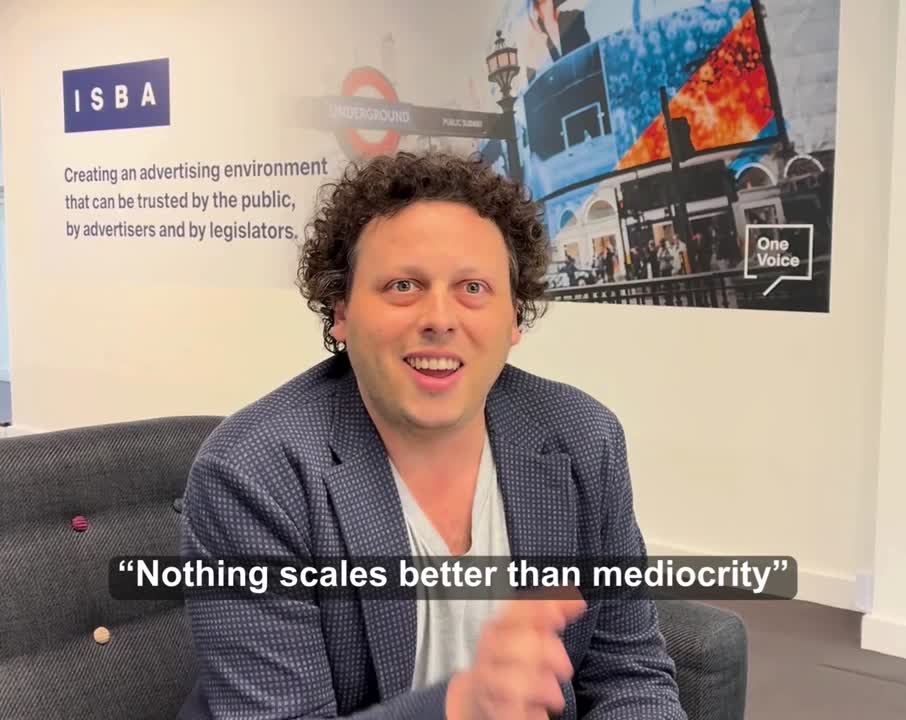
July’s ISBA survey puts a useful question in front of marketing leaders: where is the business benefit of all this AI use? With the second half of the year under way, the next resource conversation should connect a real saving to a specific piece of better work.
A marketing team can finish a campaign in fewer hours and still end the quarter with a brand that is no easier to remember, find or buy. The saving may be real. The growth has yet to happen.
That gap deserves more attention than the next demonstration of a task completed in seconds. Once AI releases time, somebody has to decide what the business gets in return. A lower bill is one possible answer. Better work is another. Neither follows automatically from a faster first draft.
In its survey published on 22 July, ISBA reported that 99% of advertisers were engaging with generative AI, while 14% reported a significant effect on business results. There were 200 advertiser responses. These are self-reports, not a controlled estimate of AI’s contribution to growth, but the distance between widespread use and substantial reported impact is a useful place to start. ISBA’s 2026 survey summary
My starting point would be to follow the work beyond the moment the model finishes. Before adding another tool to the autumn plan, make one existing saving useful.
Count the saving where the work ends
Consider a hypothetical team preparing product pages for a retailer. A model produces the first drafts quickly. Someone still checks the claims, compares the descriptions with the actual packs, removes invented benefits, approves translations and resolves the retailer’s formatting requirements. If those checks take longer, the impressive drafting time tells us little about the cost of a usable page.
The relevant comparison is between finished pages of an agreed standard. It includes the time spent preparing inputs and correcting errors. It also includes work pushed onto someone else. Five minutes saved by a marketer can become fifteen minutes of checking for the person who has to approve the claim.
Measuring this is harder than asking people whether a tool feels useful. METR’s early-2025 experiment found that 16 experienced developers took longer on familiar open-source tasks when AI was allowed, despite believing it had helped. That is evidence about those developers, tasks and tools, not a verdict on marketing or today’s models. METR’s original experiment
Its February 2026 update matters just as much. The researchers thought newer tools were probably helping more, but warned that participation and task-selection effects made their follow-up an unreliable measure of the current benefit. Repeating the old slowdown number as a universal truth would miss their own conclusion. METR’s follow-up
For a brand team, the practical lesson is modest: measure a few real jobs from brief to acceptance, at a comparable quality level. An honest estimate from your own work is more useful for allocating next month’s resources than a dramatic figure from somebody else’s demonstration.
Give the released time somewhere useful to go
Return to the retailer pages. Suppose the team confirms a meaningful saving after all the checking. It can now do several different things with that capacity.
It could fix the pages that have been neglected for months: missing information, inconsistent names, poor images, claims that never explain why the product suits a particular occasion. This is unglamorous work with a clear customer benefit. Before the team makes more pages, it can make the existing ones answer the questions shoppers actually have.
Or it could use the time earlier in the process. Instead of taking the first plausible brief into production, the team could examine the purchase situation more carefully. A product bought for a hurried weekday lunch has a different job from one bought for a dinner with friends. Research and creative development have somewhere to go once that difference is understood. More versions of a vague promise will not discover it on their own.
There is also the option of extending a good idea. A small team may previously have lacked the resources to adapt a strong campaign for an additional language or retailer. Lower production effort can make that work possible. The gain comes from reaching a useful audience with work that remains recognisably the brand’s, not from the number of files exported.
These choices compete for the same hours. A team should be able to explain which problem it is addressing and why that problem matters more than the alternatives. “Reinvest in creativity” is too vague to settle that decision. “Develop and test a second route because the current campaign is entertaining but people cannot identify the advertiser” gives the work a purpose.
Sometimes the right answer is a lower cost
It would be convenient for marketers if every saving had to stay in marketing. The case needs to be better than that.
A business under pressure may reasonably take a reduction in cost. A mature process may already produce work of the required standard; repeating it more efficiently can be valuable. Additional research can be unnecessary, and extra creative development can become an expensive way to postpone a decision.
The strongest argument for retaining capacity is therefore a specific opportunity, with an outcome the business can judge. Better information on a product page might reduce avoidable uncertainty. A stronger campaign route might improve recognition. A carefully chosen market adaptation might make an existing idea useful to more buyers. Each deserves its own evidence. None should borrow the certainty of the time saving to pretend that the commercial return has already been earned.
This also changes the conversation with agencies. If less effort is needed for routine production, the scope can reflect that. The valuable discussion is then about what expertise and work the brand needs next. Treating every saved hour as a reason to reduce the fee leaves unexplored the possibility of buying something better with the same resources. Treating every saved hour as an entitlement to retain the fee is no more persuasive.
Follow the result into the next piece of work
The useful evidence will look different from one job to another. On the retailer pages, it might begin with fewer errors and more complete answers, then examine what happens to relevant visits and purchases. For a campaign, it might begin with recognition and response, while keeping the larger commercial effect separate from those early signals.
A faster approval cycle is an operational gain. Stronger brand recognition is a marketing gain. Profitable additional sales are a commercial gain. A team can report progress at each stage without pretending that one proves the next.
The most promising consequence of cheaper execution is room to attempt work that previously lost out to deadlines: a better explanation, a more interesting idea, a neglected buying occasion. Whether that room produces growth depends on the choices made inside it.
A well-run AI programme should eventually be able to point to work that became better, or became possible, because the saving was real. That is a much more demanding achievement than ending the week with an emptier task list.
Andy Parton writes about how AI changes the work of building brands, the quality of ideas and the evidence behind marketing decisions. More from Andy.