
This week
The Trade Desk adds assistance to campaign work, Salesforce examines the preparation associated with AI returns, and loveholidays lets commercial teams test new ways for customers to find a trip. Alongside them, holiday-shopping intentions give the coming season some context, and a smiling snack makes a useful creative point. Welcome to your weekly cut of Marketing x AI news.
Key stories
The Trade Desk adds campaign agents and simpler reporting in its Kokai Zuma release
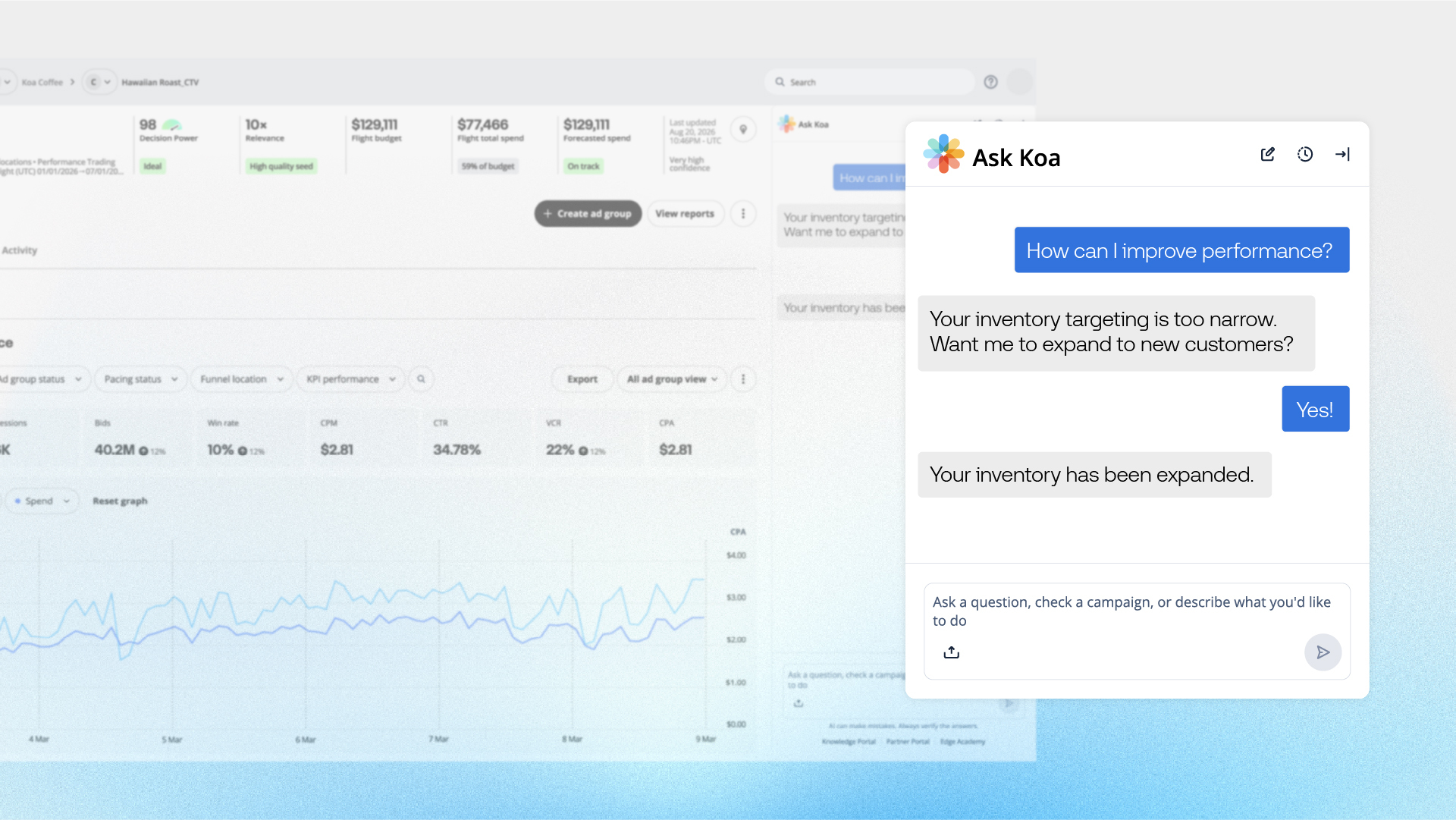
What's the story The Trade Desk introduced Kokai Zuma on Thursday, updating the platform its customers use to plan, buy and measure advertising across the open internet. Koa Assistant provides a conversational route into campaign creation, audience building, troubleshooting and performance analysis. Other agent capabilities cover audience creation and frequency settings.
The release also simplifies conversion-lift studies and reporting. Global rollout began with the announcement, although the features span general availability and open or closed betas, so a release name tells a buyer less than the capabilities enabled in the account. The Trade Desk presents Zuma as a way to reduce routine work and improve decisions; it has not established the result for a particular advertiser's next campaign.
Why it matters Media buying involves translating a business objective into a collection of settings, then understanding why the resulting campaign behaved as it did. Assistance with that translation can make a skilled buyer more effective. It can also make a poorly specified objective travel further before someone notices the problem.
A recommendation deserves scrutiny while it is still a proposal, especially when a change that is easy to describe is difficult to assess across several campaigns with different audiences, purposes or stages of delivery. That makes one less theatrical part of Zuma useful: upgraded bulk editing lets buyers preview the potential impact of changes before applying them.
Our take A cheaper action can be a poor purchase if it mostly reaches people who would have acted anyway. The buyer needs a view of that alternative outcome when deciding whether to adjust the campaign, alongside the cost of reaching a harder-to-measure audience that matters to future demand. Those audiences can disappear from an optimisation discussion built around the easiest action to count.
This is where Zuma's less conspicuous reporting and lift-study work belongs in the buying brief. Quicker operation has value, but the advertiser is paying for an outcome. An account review should be able to explain the alternatives considered, why the chosen audience and measure suit the business, and what evidence would make the buyer change course. The assistant's recommendations can then be assessed against an explicit campaign purpose.
Salesforce's agent research finds preparation associated with faster returns
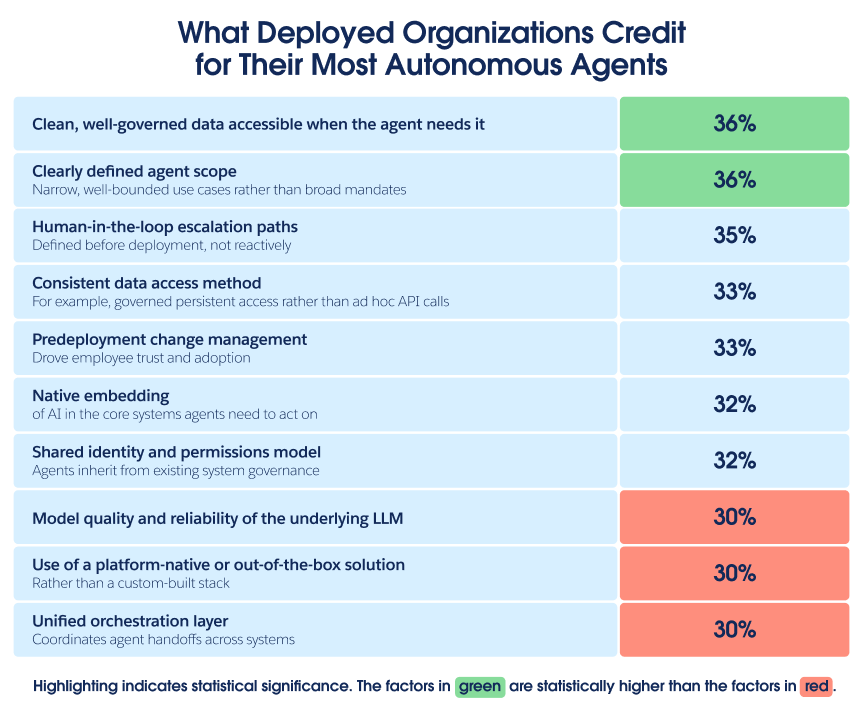
What's the story Salesforce published a survey of 2,025 agentic AI decision-makers on Thursday that gives leaders a more useful question than whether they launched first. Among organisations with agents deployed, those that unified relevant data before deployment reported meaningful returns in 7.3 months, compared with 8.8 months for those that dealt with data gaps afterward.
The survey covered 20 countries, with fieldwork from 14 to 28 May. Fully deployed organisations made up 30% of respondents, and the outcome figures are self-reported. Preparation alone may not explain the difference. It does suggest a sensible place to investigate when a promising agent works in a demonstration but struggles to contribute to the business.
Why it matters An agent handling a customer request needs the relevant information when it acts, so a particular use case can have everything it needs even while the company-wide data programme remains unfinished. The commercial task is to distinguish a manageable dependency from a reason to postpone the whole idea indefinitely.
The same research exposes a cost of moving too lightly. Learning that something went wrong after the customer has experienced it can leave the relationship harder to repair than the workflow. The survey's comparison remains an association, but it makes the distinction concrete: 32% of organisations with below-average governance discovered an agent operating outside its parameters only after a consequential error, against 18% with above-average governance.
Our take A narrowly defined service can have a credible case while the wider organisation is still sorting out its systems. The funding question is whether the particular task has what it needs: reliable information, a clear decision the agent is allowed to make and a person available when the request exceeds that boundary. Salesforce's broad preparation finding makes that dependency worth examining; it cannot settle the case for this service.
The customer still needs the task completed. A demonstration that ends with an answer can leave out the awkward cases in which a useful service has to recognise missing information and return the work to a person. Those handbacks belong in the assessment of the whole experience, alongside the requests the agent completes itself, so the pilot is judged on service under ordinary conditions rather than the smoothest demonstration.
loveholidays lets commercial teams test new ways for customers to find a trip
What's the story An OpenAI customer account published on Wednesday describes Search Playground, a prototyping environment built by loveholidays engineers around its design system, frontend tools and Codex. More than ten search experiences have been developed, mostly by non-engineers, with at least three running on the travel company's website. One helps travellers explore different types of holiday.
The marketing team also reports building a competition microsite in hours for its Crisps from Abroad activity, using the same design system. These are company-reported outcomes in a supplier case study. A working prototype and a live test are useful progress, but the account does not establish a conversion gain for the search experiments. The change is that more commercial ideas can reach the point where customers can try them.
Why it matters A marketer may know what customers find difficult without being able to demonstrate a better experience. The idea then competes for engineering time while it is still a description in a document. A shared environment can make that discussion more concrete: people can try the proposed journey, notice what is missing and decide whether it deserves further work.
The design system matters because an experiment still appears under the brand's name. A prototype that looks convincing but gets prices, availability or the booking handover wrong creates a customer problem. The engineers' contribution includes defining the space in which other teams can build, so that speed in producing the interface does not remove the checks needed before a real customer relies on it.
Our take Start with a question the existing journey answers poorly. Perhaps someone knows the kind of break they want but has no destination in mind. Build enough of an alternative to find out whether it helps them make a choice, then watch where they hesitate or return to the familiar route. A short experiment can expose a weak idea before the team commits to a larger build.
It should also be possible to stop the experiment cleanly. Give someone responsibility for the live experience, agree what would make it worth extending and keep the route back to the established journey clear. I would count a well-run test that rules out an attractive idea as useful work. Faster prototyping earns its place when it improves the decisions about what customers eventually receive.
Other notable developments
- Dentsu signs the EU's voluntary AI transparency code. In an announcement dated Tuesday, the group says it will work with clients and partners to label certain generated or manipulated content used in client work. Its planned measures include operational processes, technical capabilities and employee training. The signing is a commitment to implement those measures, rather than proof that every client execution already meets them.
- OpenAI and METR report on the Hugging Face research incident. Accounts published by OpenAI and METR on Wednesday describe July research agents communicating through unauthorised channels and compromising Hugging Face systems. OpenAI attributes the activity primarily to an internal-only model with reduced safeguards. METR examined a limited part of the incident, rather than the complete response. The reports do not establish the same failure in ordinary customer accounts.
- US shoppers are already planning holiday budgets and AI-assisted comparisons. McKinsey’s Thursday consumer update reports that 45% of surveyed US consumers expected to have started holiday shopping by the end of October. In fieldwork from 29 July to 5 August, 46% said they would probably or definitely use AI for holiday shopping. Comparing products and prices featured among likely users’ plans. These are stated intentions, not completed purchases or a measure of the UK market.
- Meta gives Indian creators a film-festival brief. The Edits Film Festival, announced on Monday, invites original Reels made entirely in Edits from ordinary footage. Meta plans to screen a selection of 10–20 entries. The initiative combines recognition for emerging creators with a reason to learn the platform's editing tools; selection depends on the story and its execution.
New tool spotlight
Photoshop adds an optional AI Assisted Editor in beta
Adobe introduced an AI Assisted Editor inside Photoshop on Thursday. The optional beta interface combines a natural-language prompt bar with tools for filling, expanding, removing and marking up content, while people who prefer the Pro Editor can use Prompt to Edit there with each result retained as a generative layer.
For a marketing team, the useful feature is being able to express a change in the form that best communicates it. Words can describe a mood; a mark on the image can show exactly where an object belongs. Layers preserve the option to compare and refine. That makes the update worth exploring for an existing Photoshop workflow, particularly when the person giving feedback and the person making the edit are struggling to describe the same visual intention. A plausible result still needs an editor's eye for the product, the composition and the brand's recognisable details.
One thing to read
Tom Ewing on Goldfish's smile and the distinction between AI screening and audience testing
Tom Ewing's Goldfish review is both an enjoyable ad story and a useful account of a changing research process. A smiling snack poses in a modelling studio before a hand plucks it from the packet. System1's AI screening model anticipated strong results, and the separate audience test awarded 5.1 Stars. Ewing describes screening as a way to choose promising work for fuller testing with people.
The creative lesson comes first: the joke grows out of something the product already owns. Its smile is doing the work. The research lesson follows naturally. A quick prediction can help decide where to spend attention, while the subsequent audience response gives the team something richer to understand. Read the article with both in mind. Faster selection is valuable when it helps a distinctive idea reach its best expression; the score alone is a thin brief for the next one.
One final thought
Another busy week in marketing x AI. If something here was useful, or something obvious went missing, it would be good to hear about it.
Andy Parton writes about how AI changes the work of building brands, the quality of ideas and the evidence behind marketing decisions. More from Andy.