This week
Consumers distinguish between AI helping to make an ad and creating the people in it. Gallup gives that distinction some evidence, Adobe expands audio production in Firefly, and an NVIDIA event-planning case describes where saved time can go. The week ends with the BBC and the value of reminding an audience what it already recognises. Welcome to your weekly cut of Marketing x AI news.
Key stories
Gallup finds Americans more comfortable with AI helping to make ads than making the people in them
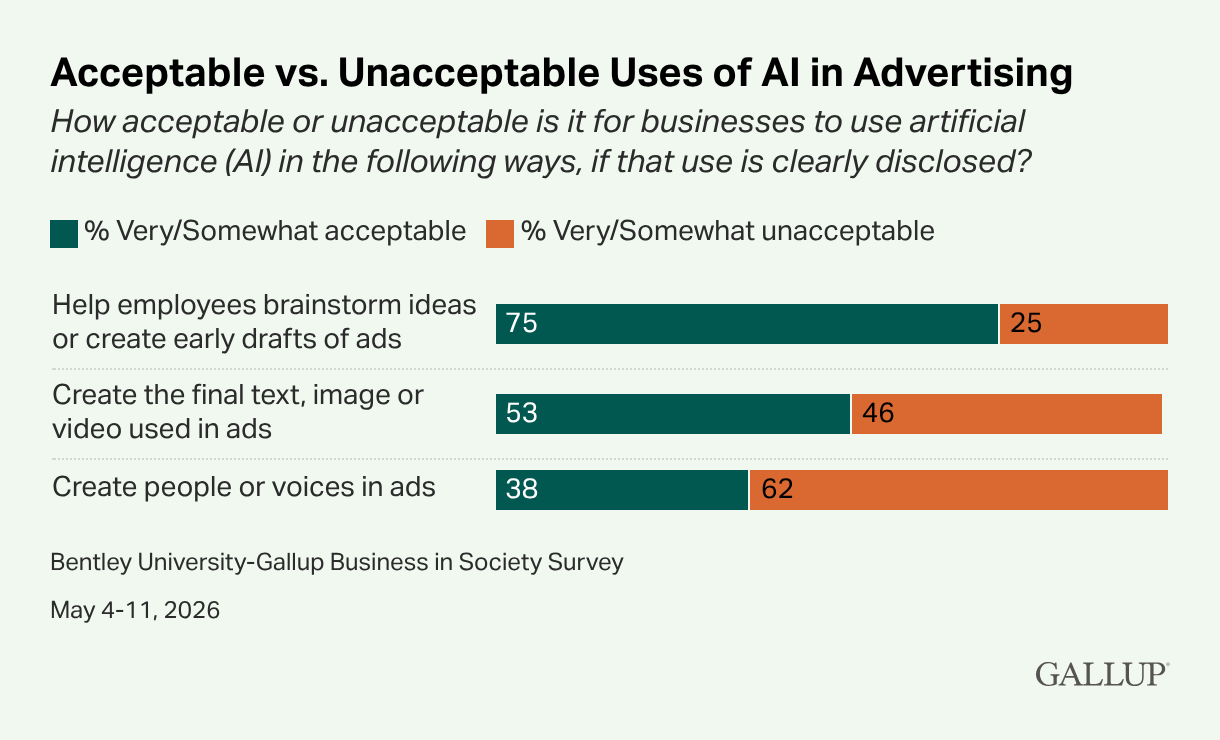
What's the story Nearly half of Americans view businesses' use of AI to create advertisements negatively, according to Bentley-Gallup findings published on Wednesday. The split was 49% negative, 19% positive and 32% neutral. That is a useful warning for anyone assuming that wider exposure automatically makes a production method more welcome.
The answers became more permissive when the question described a particular use. With clear disclosure, 75% considered it acceptable for AI to help employees brainstorm or produce early drafts; 53% accepted it creating final advertising text, images or video. Gallup is reporting US adults' attitudes. These figures do not measure whether an AI-made campaign sold more, or establish how a UK audience would respond.
Why it matters A single question about whether a brand should use AI conceals several creative decisions. A team can use it to explore an idea, translate an execution or make a person appear to say something. Those choices ask different things of the audience. Approval for one cannot simply be carried across to the others.
Disclosure also has a limit. A label explains the method, while the emotional force of an ad may depend on believing in the person on screen. A testimony or demonstration asks for trust in ways that an obviously fanciful scene may not. The survey gives that distinction weight: 62% considered AI-created people or voices in ads unacceptable even when the use was clearly disclosed.
Our take Start the creative discussion with what the audience is being asked to believe. It is a more productive question than whether the team can defend the software it used. A synthetic character in a comic world and a synthetic customer describing a life-changing purchase create very different expectations, even if the production tool is identical and both executions carry an equally prominent explanation of how the imagery was made.
The survey gives that discussion a reason to happen early, without supplying a universal veto on generated work or implying that a favourable answer in a survey would make a weak ad compelling. The creative still has to earn attention. Where a human experience is the reason to believe the message, however, replacing the person can remove the very thing the brand hoped to borrow. Efficiency should support the idea that makes the communication credible. Otherwise, the production saving becomes an expensive way to weaken it.
Adobe makes music, speech and sound effects broadly available inside Firefly

What's the story Adobe made Firefly's three audio-generation tools generally available on Thursday. Generate Music produces tracks fitted to a video's length and mood. Generate Speech turns scripts into voiceovers with controls for delivery. Generate Sound Effects creates sounds to match the action in a piece of content.
The commercial proposition is a more complete creative workspace: pictures, video and their soundtrack can be developed together. Adobe describes the resulting audio as commercially safe and its generated music as universally licensed. Those are Adobe's claims about the product; a team's intended use still needs to fit the applicable terms. The announcement does not demonstrate that generated sound improves an audience's response.
Why it matters Audio is a creative decision that becomes harder when it arrives after everything else is fixed. A voice can change the meaning of a line. Music can make a modest claim feel confident, sentimental or absurd. Bringing those decisions closer to the first cut gives a team more opportunity to discover that the tone is wrong while changing it remains cheap.
For a small marketing team, hearing alternatives before a brief hardens into instructions can reveal a problem that is difficult to spot on the page. A line may sound awkward; a choice of music may overwhelm the voice the viewer needs to hear. Trying those directions is becoming easier to justify: alongside the audio release, Adobe announced a free Firefly AI Assistant experience with daily generations.
Our take Give the soundtrack a role in the brand idea. A generic request for something upbeat is likely to produce an interchangeable answer, however accomplished the software. The more useful brief explains what the viewer should feel at a particular moment and how that feeling belongs to this brand. Sometimes the scene needs silence.
This is an opportunity for creative directors to work with sound earlier. It is also a reason to preserve distinctive audio assets when variations become plentiful. A familiar rhythm or voice can connect work across formats; replacing it simply because a fresh version is easy may spend the recognition built through years of consistent exposure without giving the audience a better reason to remember the brand.
NVIDIA's event-planning example puts the saved hours to work with customers
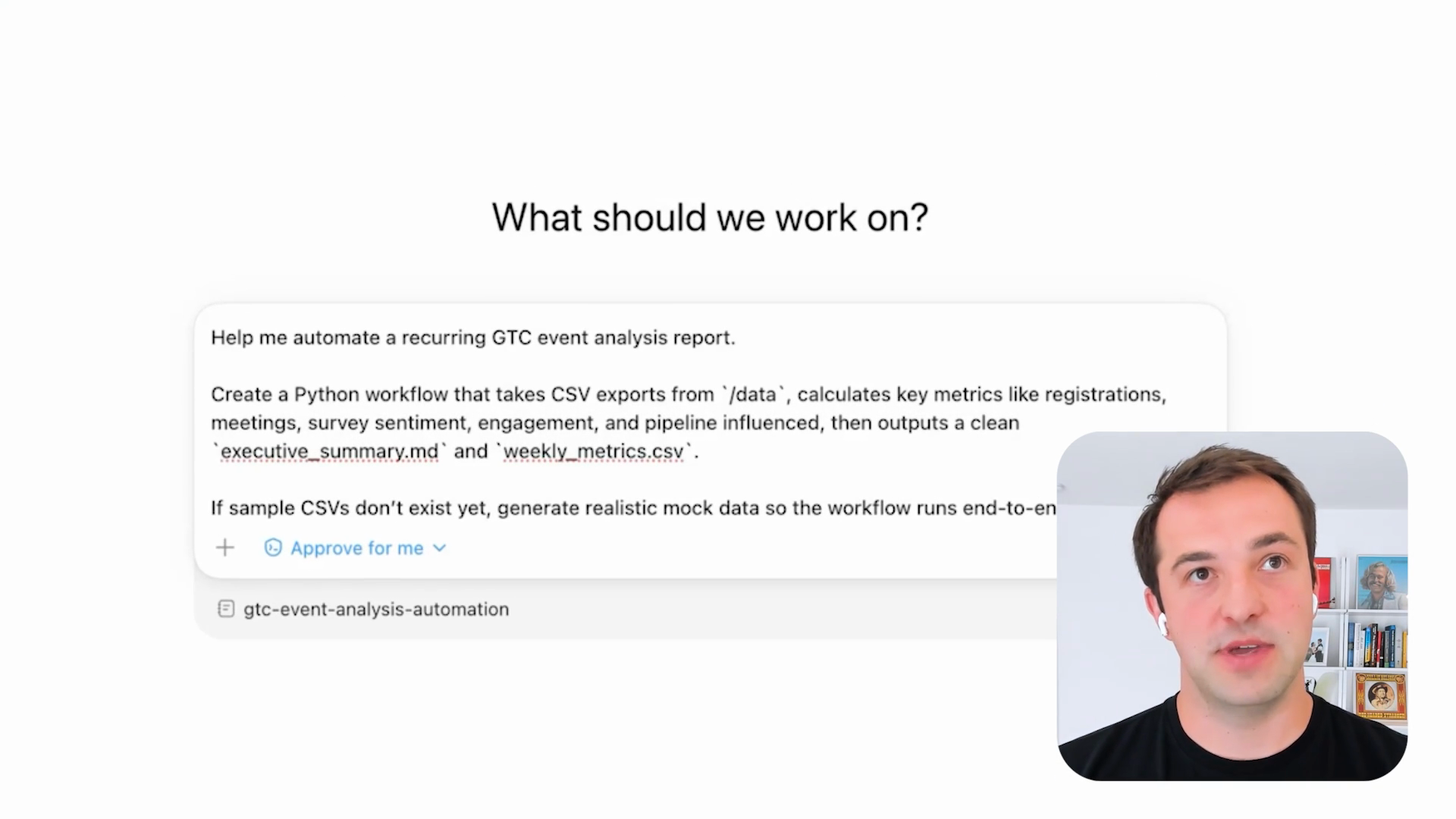
What's the story An OpenAI customer account published on Tuesday describes how NVIDIA's Will Daney uses ChatGPT Work during preparations for its GTC conference. The work includes assembling account lists, following registrations and helping field teams plan customer activity. He estimates that an automated process saves around 16 hours a week over the 12-week planning cycle.
The case says he uses the released time to work more closely with the field team and help it support customers. Colleagues have adapted the workflow for events in other regions. This is a named person's experience in a supplier-hosted case study, not an independently measured productivity rate for the whole company. It does not report a controlled comparison of event outcomes, customer satisfaction or sales generated by the change.
Why it matters Event preparation is a useful place to examine the capacity argument because the administrative work has an obvious purpose. A registration list helps someone arrange the right conversation; the spreadsheet is a means to that end. If compiling it takes less time, the next question is whether the team can do a better job of planning and following through on those conversations.
There is a practical distinction between time released and time available. A fragmented hour between meetings may not be enough to improve a customer programme, even if the weekly total looks substantial. The manager needs to decide what work can move into that space and give it enough room to happen. Otherwise, a promising saving can disappear into a slightly busier calendar without changing the experience at the event.
Our take For the next event, choose one recurring preparation task and keep the old output for comparison. Check whether the automated version is accurate and useful to the people organising the meetings. Count the review and repair time, then agree which neglected activity should receive any capacity that remains. A shorter preparation cycle can be worthwhile even when it does not release a whole role.
The more interesting measure comes after that. Did the field team have better conversations, resolve more of the customer's questions or follow up with something relevant? Those outcomes need their own evidence. NVIDIA's example makes the destination of the saved hours visible. That is a stronger starting point for a marketing pilot than a target to use an assistant more often.
Other notable developments
- IAB updates its AI disclosure framework. The second version, published on Tuesday, translates its risk-based approach into practical disclosure guidance for advertising and marketing. The published overview covers generated and assisted content, synthetic voices, digital twins and consumer interactions. This is an industry framework; its overview describes recommended practices, rather than announcing a new statutory obligation.
- Forrester offers a model of where AI changes technology markets. Wednesday's release applies its analysis to 17 categories containing more than 200 markets. It expects pressure on labour-intensive services including creative work and localisation, while marketing technology is among the categories it expects to be reshaped. These are analyst expectations about markets, not measured job losses or a result for an individual business.
- Meta opens Startup School for Indian consumer brands. The programme announced on Wednesday starts on 1 September with 200 businesses and three months of learning and complimentary agency consultation. Eligibility excludes businesses directly managed by Meta or already working with an agency. The curriculum centres on Meta's advertising and AI tools, so this is platform-specific support for an eligible cohort.
- Asana reports using coding agents to clear a long-standing obstacle. Tuesday’s OpenAI customer account describes Asana using Codex on a software migration it had expected to carry for years. The case illustrates work becoming practical when the effort of implementation falls. It is a company-reported engineering result, rather than a demonstrated marketing productivity rate or evidence that every old system can now be replaced at the same speed.
New tool spotlight
Replit introduces Free Mode for shaping an idea before building it
Replit introduced Free Mode in an account published on Wednesday. It uses GPT-5.6 Luna to answer questions, give feedback and explore ideas without consuming usage. The useful distinction is between working through an idea and moving into Build Mode. The announcement describes continuity between those stages, rather than a promise that every completed application can be built and deployed without cost.
For a marketer planning an interactive tool, that creates room to refine the brief. A calculator, product selector or event guide starts with a decision the visitor needs to make. Exploring that decision before requesting screens can reveal whether the proposed tool actually helps, what information it needs and where a person should take over. Keeping the discussion in the same project may help carry that refinement into a build that works for a real visitor.
One thing to read
Daniel Kent-Smith on the BBC reminding viewers what belongs to it
Daniel Kent-Smith's review of the BBC's new brand film looks at a familiar idea made useful again. Romesh Ranganathan encounters the corporation's programmes, places and personalities as the film asks what the BBC has done for its audience. System1 gives the work 3.4 Stars, a predictive effectiveness rating, and Kent-Smith explains how cultural references make the breadth of the offer entertaining.
Read it for the difference between listing assets and making people feel their value. Many organisations can assemble a long catalogue of what they produce. Fewer can turn that catalogue into a coherent experience that an audience wants to watch. The BBC has a rich store to draw on; the creative task is choosing and connecting the parts. More available material increases the need for an editor who knows what belongs in the story.
One final thought
Another busy week in marketing x AI. If something here was useful, or something obvious went missing, it would be good to hear about it.
Andy Parton writes about how AI changes the work of building brands, the quality of ideas and the evidence behind marketing decisions. More from Andy.