
This week
Much of this week's coverage has been about whether AI should slow down, whether Sydney Sweeney's Novig campaign went too far, and whether people want to talk to an advertisement. There is a useful marketing question underneath each: who are you trying to convince, and what is getting in their way?
For the AI labs, better technology alone may not overcome people's reservations. For Novig, being largely unknown is arguably a much greater commercial challenge than its advertising sparking controversy. OpenAI's new format could help a customer make an expensive decision, or turn a simple purchase into an unnecessarily long conversation.
We cover all of this and more in this week's Weekly Cut of Marketing x AI news.
Key stories
AI labs invite independent scrutiny; but are they looking to help prevent the AI apocalypse or simply support lofty IPO valuations?
What's the story
Anthropic CEO Dario Amodei's proposal to pace frontier AI development includes a commitment to embed independent evaluators at Anthropic, with extensive internal access and the ability to publish findings without the company's editorial control. Americans for Responsible Innovation welcomed commitments from Amodei and Sam Altman on 12 September. Elon Musk also backed Amodei’s call, writing “Dario is right.” The wider proposal includes coordination between labs and government action; it is not an agreed industry settlement.
“Subject to limited redactions” is a consequential qualification, but it does not give Anthropic permission to remove findings simply because they are unfavourable. Amodei distinguishes limits on access for legal, contractual and third-party privacy reasons from redactions of specified sensitive information before publication. Evaluators would be able to flag consequential omissions publicly. These are proposed arrangements, with their value still to be demonstrated in practice.
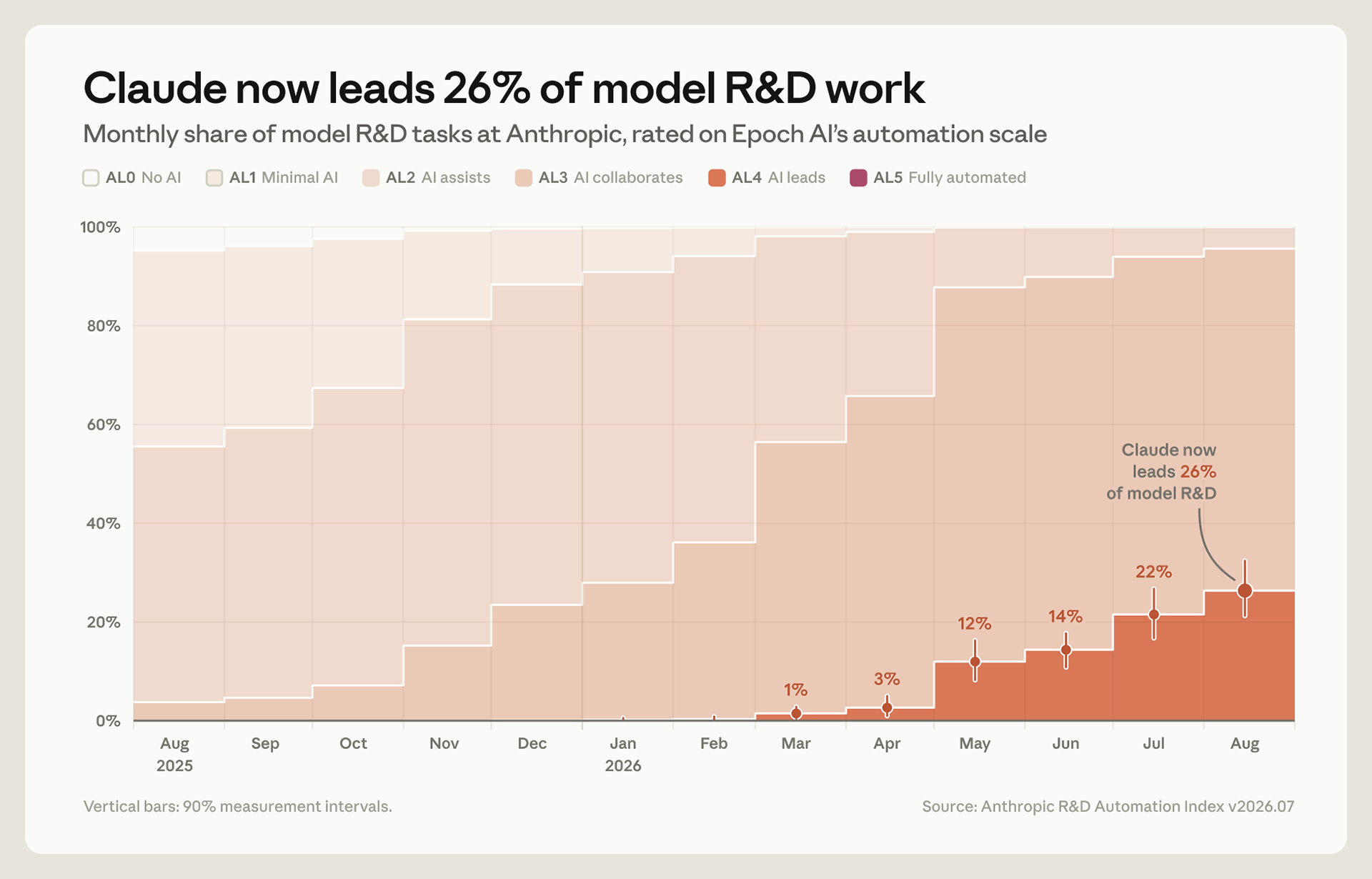
The pace of change gives this some urgency. In a separate report published on 17 September, Anthropic estimated that AI led 26% of its R&D work in August, under human supervision.
Why it matters
Last week's Cut examined the consequences of AI testing moving beyond the lab. Independent evaluation could help people understand that work and make better decisions about using the resulting technology. There is also a substantial commercial opportunity in changing how the category is perceived.
I have spent a good part of my career working on consumer trust in categories where the evidence and public perception were a long way apart. Accumulating more evidence did not automatically close that gap. People needed a reason to reconsider what they already believed, and the organisation delivering the message mattered.
That is why an independent assessment can do something a company's own assurances struggle to do. It gives a hesitant customer another basis for making a decision. For AI businesses whose ambitions depend on people using their products for more consequential work, that confidence could be enormously valuable.
Our take
As those of you who know me personally, or who have been subscribed to the Weekly Cut for a while, know very well, I am very much pro-AI. I want to see more of the technology's potential realised, and that requires people to feel comfortable using it. The labs' commercial interest in improving confidence is entirely compatible with doing useful safety work. Both can benefit from the same investment.
The terms matter. People must be able to understand what the evaluators could examine and what their findings actually establish. Otherwise, the labs may do valuable work that leaves public perceptions largely untouched. I would support the investment in credible scrutiny and communicating its results without signing up to Amodei's wider policy prescription.
For readers working in large companies, this has a very practical application. Many of you are trying to make the case for AI while legal and risk teams challenge how it will be used. Greater transparency from model owners should be welcomed: it gives those conversations a stronger evidence base and helps people understand which concerns have been addressed, and which still need attention in their particular use case.
Novig's Sweeney campaign attracts criticism—and an audience a challenger needs.
What's the story
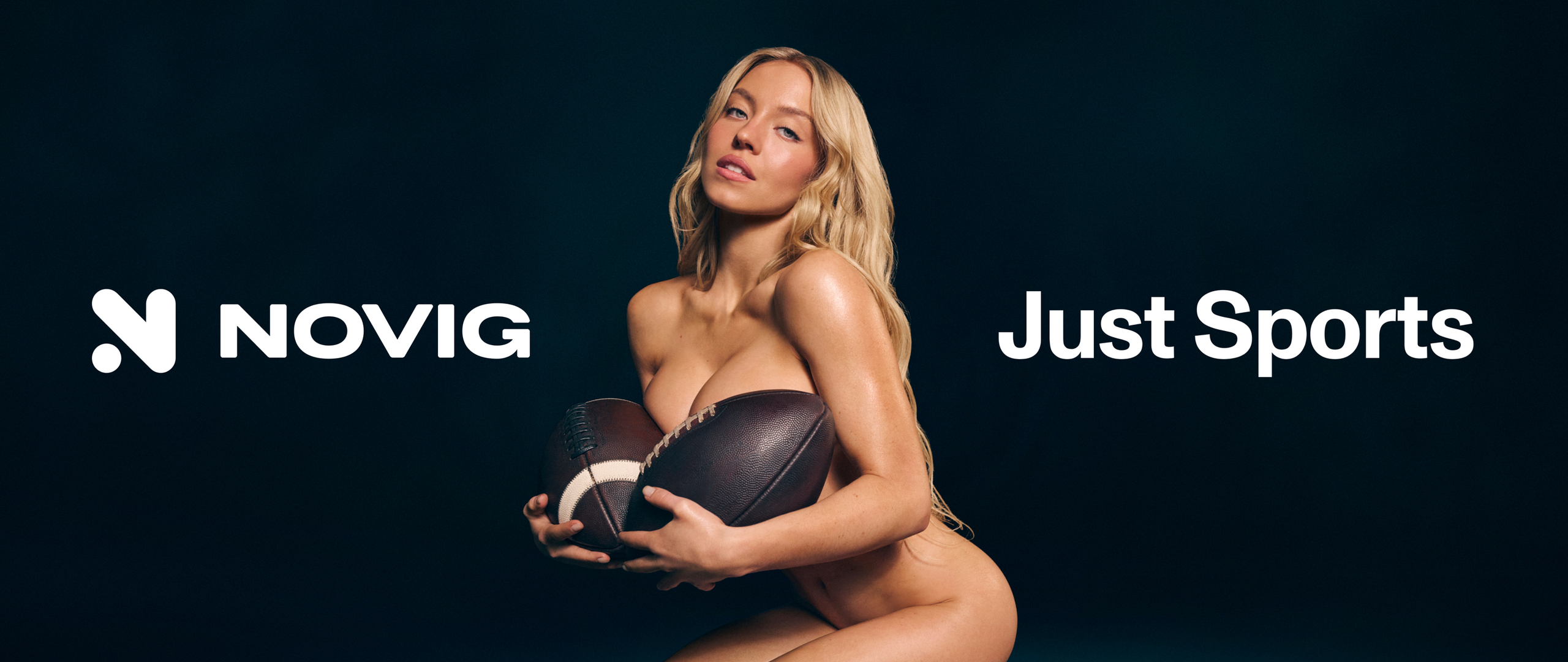
Novig's Just Sports campaign launched on 9 September, with Sydney Sweeney as a strategic partner and equity holder. Its sports-equipment conceit promotes a platform focused on sports rather than the wider assortment of contracts offered by prediction markets. The resulting uproar has spread through advertising and creative circles and across social commentary, with critics panning its sexualisation of women's sport and its attention-first approach. Industry commentary and creative-agency perspectives show how far the debate extends beyond the original ad. Chief executive Jacob Fortinsky has defended the work and Sweeney's involvement in its creative direction.
Front Office Sports' coverage, published on 15 September and updated on 16 September, reported more than 12 million views on X and 47 million on Instagram. Fortinsky said Novig needed to close an awareness gap with Kalshi and Polymarket. He also cited more than $1 billion in cumulative platform trading volume. That gives us useful context about the business, although it cannot isolate the campaign's contribution.
Novig is a small challenger competing for attention with Kalshi, Polymarket and established betting brands such as DraftKings and BetMGM. Covers, citing Aldrin Research, put Novig at just 1.7% of notional trading volume across 11 tracked prediction exchanges in the week to 16 September. The social conversation around this campaign looks remarkably large against that small commercial footprint.
Instagram · 20 September update
An entirely different scale of response.
| Metric | Sweeney launch reel | Earlier Novig post |
|---|---|---|
| Likes | 1.3m | 621 |
| Comments | 65,000 | 41 |
| Reposts | 21,500 | 11 |
| Shares | 3m | 455 |
Source: author’s Instagram snapshot, 20 September. Sweeney launch reel and an earlier post on Novig’s feed. Rounded counters; engagement is not unique reach. Different content, distribution and media support make this a directional comparison.
The video-view comparison is striking too. On 20 September, Novig’s reel grid showed 61.3 million views for the Sweeney film, against 134,000 for the preceding reel, posted on 8 September: about 457 times as many. This is an imperfect comparison, but it gives a clear indication of the campaign’s ability to get Novig seen and discussed.
Why it matters
A brand gains strength when people feel it understands them: their interests, their tastes, the kind of person they see themselves as. Novig appears to be making a deliberate choice about that audience. S&P Global's March 2025 US survey found that 68% of online sports bettors were men and 43% were under 35. That makes the audience hypothesis plausible; it does not establish those people's response to this particular campaign.
The criticism deserves to be understood on its own terms. Its commercial significance also depends on whether it changes the minds of people Novig is trying to recruit. A strong objection from one group and an effective appeal to another can coexist. We should be careful about treating the loudest visible reaction as a representative customer survey.
For a challenger, the alternative to provocation may be spending a smaller budget on perfectly acceptable advertising that few people notice. Established competitors already have familiarity on their side. Against that starting point, the scale of attention Novig has earned is a meaningful early result.
Our take
I am more positive about this campaign's prospects than the backlash might suggest. That does not require me to think it is exceptional creative work. Judged through the brand-building approach in our Playbook (launching 30 September), the audience choice is intelligible and the ability to interrupt attention is evident. The less settled question is how much meaningful difference it establishes for Novig.
“Just Sports” gives the provocation a connection to the proposition. As we argued in More executions. How many ideas?, the brand needs a useful role in the idea. Novig has more to work with here than a celebrity appearing beside an interchangeable logo.
I would give the campaign credit for capturing what looks to me like a disproportionately high share of voice, social conversation and attention for a relatively small challenger in a saturated market. Kalshi, Polymarket, DraftKings and BetMGM give it formidable competition for space in consumers' minds and routes to their custom. We do not have a formal share-of-voice study, but the contrast with Novig's own previous content is striking.
I, for one, will be fascinated to see credible performance numbers over the coming weeks and months: whether Novig can capitalise on this awareness spike through consideration, conversion, trial and retention, and what precisely Sydney Sweeney's role as a “strategic partner” involves beyond her equity stake.
OpenAI tests conversational ads, with the strongest case in considered purchases.
What's the story
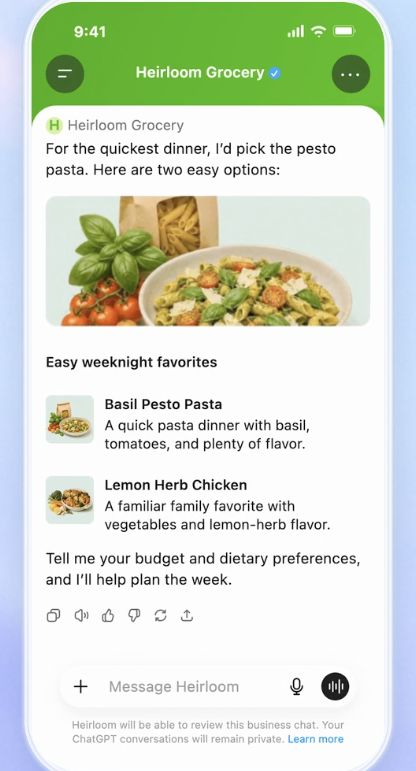
OpenAI introduced Sponsored Agents on 16 September, in a test with selected US advertisers. People can open a labelled, brand-specific conversation from an ad, ask questions and follow a link to the merchant. The sponsored conversation is separate from ChatGPT's original answer. Digiday reported on the emerging click-to-chat format earlier in the week.
Why it matters
A conventional ad has limited room to address whatever is holding a particular customer back. One buyer needs to understand compatibility; another is comparing two expensive options; somebody considering a complex service wants to know whether it covers their circumstances. A conversation could respond to the actual obstacle instead of hoping the right paragraph is somewhere on the landing page.
That makes the format especially interesting for purchases with a longer consideration period. It gives a brand time to explain its value while the customer is actively trying to decide. Our May analysis explored the continuing role of brand preference when AI provides the buying answer. Here, an advertiser gets a direct opportunity to make its case through a useful exchange.
Our take
This could be a really interesting opportunity for brands in categories where the consumer journey is long, convoluted or complex, and where unanswered questions are a real barrier to purchase. The category and the task matter more than the novelty of the format. Turning a familiar thirty-second purchase into a three-minute conversation could destroy your conversion rates.
That being said, my own circle of paying AI users made me wonder whether the customers considering those purchases would be reachable through this inventory. ChatGPT advertising reaches Free and Go users, while Plus, Pro and Enterprise remain ad-free. While I have not found evidence that concretely links ChatGPT subscription tier to consumer purchasing power, I do wonder whether consumers on free or basic tiers will be the optimal test audience for this new advertising functionality for many brands.
For the right business, this could put a much better explanation in front of a receptive buyer. I would judge it by the hesitation it resolves and the business it produces. Time spent chatting could mean helpful advice—or a customer still struggling to get an answer.
Other notable developments
-
California signs an AI-ad disclosure law; the ASA applies existing rules. In further regulatory developments, California's governor signed SB 1050 on 16 September, requiring disclosures for qualifying synthetic performers in advertising. Separately, the UK's ASA published rulings against AI-tool ads under existing rules on harm, offence and responsibility.
-
Google expands retailers' view of AI shopping. Its 16 September update makes Merchant Center AI performance insights available in Australia, Canada, India, New Zealand and the US. A US beta brings Business Agent into YouTube ads. Universal Commerce Protocol features including cart transfer and checkout testing are rolling out gradually in the US.
-
Only 17% identified the AI ad in COOL's test. The company's 17 September research release reports that more than 500 US consumers saw ten ads, one made with COOL AI. Just 17% picked it. The finding concerns that particular set of ads. Asked about disclosure, 40% said it would reduce brand trust, 40% reported no change and 20% greater trust.
-
Pinterest previews ads that respond to visual searches. The company announced visual-search performance ads on 17 September, with a beta due in eligible advertising markets over the following weeks.
New tool spotlight
HubSpot brings ChatGPT advertising into its CRM.
HubSpot's ChatGPT Ads integration entered public beta on 16 September. Available from Marketing Hub Free with a ChatGPT Ads account, it connects campaign activity with contact and conversion reporting. OpenAI and HubSpot describe it as the first CRM integration for ChatGPT Ads. Access to the separate Sponsored Agents test is not included.
I wanted to understand whether this gives HubSpot a useful advantage or simply catches it up with AI-native competitors. Here at Destreza, we chose Attio after looking at that newer generation of CRM tools; its February release already let compatible AI assistants work with CRM data. HubSpot's announcement is more specific: bringing this advertising channel into the system where a marketing team manages customers and measures outcomes.
That is a practical reason for existing HubSpot users to try it. A team can look beyond ad engagement to the contacts and subsequent business it generates, with consent and conversion-event configuration handled properly. HubSpot is giving its existing customers a way to account for a new advertising channel inside the CRM they already use. So if you're already using HubSpot, in our view this is definitely worth trialling.
One thing to watch
IAB Europe's Great Debate on AI
The recording of IAB Europe's 10 September event became available on 15 September. Start with the closing creative debate at 1:29:23, which runs for about 33 minutes. The disagreement over whether cheaper execution makes advertising more interchangeable is worth your time, especially alongside our August piece on distinctive ideas. The participants put different weight on the economics of production and the role of creative direction; there is more to consider here than the room's final vote.
Weekly hot take
Given the online discourse this week, this is definitely one of my hotter takes. But I strongly believe that when the dust settles, provided Novig has a strong product and good CX, the Sweeney campaign will be a net positive for the business.
Will the Sweeney campaign be a net positive for Novig?
Loading the poll…
Percentages shown; response totals stay private. One saved choice per browser, which you can change. An informal reader poll.
One final thought
I expect the visual gap between obviously AI-generated advertising and work people cannot readily distinguish to keep narrowing. COOL's test is a limited example, not proof of that trajectory. As the execution improves, a convincing-looking ad will tell us less about how much human judgement went into it.
The combination of this week's stories feels rather familiar. Imagine a brand-sponsored AI conversation producing an answer that attracts the kind of backlash Novig has faced. The brand commissioned the activity, another company supplied the model, and the customer has already shared the exchange before anyone agrees what went wrong. That is a much more immediate prospect for most marketing teams than many of the doomsday scenarios dominating the AI debate.
One of my teams encountered an earlier version of this problem. We used AI-assisted creative optimisation to refine a campaign, developing more variations around the executions doing best and directing more budget towards them. Over successive rounds, the work moved further into familiar category conventions, even though the brand's ambition was to move beyond them. Each iteration had a performance rationale. Taken together, they produced work we were heavily criticised for running.
That experience really hammered home the importance of understanding exciting new technology and using it with precision and judgement. It is easy to get distracted by what a new tool can do, particularly when the early performance numbers look encouraging. We needed to understand how the optimisation process was steering the work and recognise when its direction conflicted with our wider ambition for the brand.
I remain excited about what these tools make possible. Getting the benefit requires skill: knowing what the system is rewarding, staying involved as the work evolves, and challenging an apparently successful result when it is taking the brand somewhere it should not go. Otherwise, unintended consequences can overshadow the performance gains that made the campaign look successful in the first place.
Andy Parton
Founder, Destreza