This week
The Christmas ads have arrived, in a festive quarter the Advertising Association and WARC forecast at £14 billion of UK ad spend. John Lewis launched its 20th on 3 November, with a Dame, a talking toy dog and a Sam Fender cover. M&S followed on 6 November with The Home of Christmas: James Norton as a beardless Santa who slips into London unrecognised, in its first Christmas campaign since 2017 to bring food, fashion, home and beauty together. Both are getting wall-to-wall coverage.
Rather than add to that, I want to point you at Very, whose AI-assisted Christmas ad is, by Very’s account, the highest-scoring it has ever tested. And at Dior, whose hand-drawn holiday film is facing accusations online that it wasn’t entirely hand-drawn.
Adobe, meanwhile, has put its marketing software inside ChatGPT, Claude, Gemini and Copilot. Further down: OpenAI’s images learn to animate, Anthropic’s first quarterly update since filing to go public and Google’s new video model.
All this and more in your weekly cut of marketing AI news.
Key stories
Very’s AI-assisted Christmas ad is the best it has ever tested

What’s the story?
Very’s Christmas campaign, ‘That’s the Very Thing’, went live on 1 November. It introduces a new flamingo family: a young flamingo hunts for his dream present, and Very’s pink box opens as a portal into worlds built from gifts the retailer sells. Very calls it its first campaign made with a hybrid CGI and AI-assisted production process, by The Gate and M3Labs, directed by Peter Lee-Scott.
Very says the film scored 5.9 stars in pre-launch testing with System1, the top of the scale. That is its highest score ever, and it puts the film in the top 1% of retail ads tested with its target audience.
Why it matters
Coca-Cola’s AI-made Christmas ad in 2024 drew an industry and press backlash, yet System1’s testing gave it the same 5.9 stars on the strength of trucks and Santa that viewers have known for almost 30 years. System1’s star rating predicts long-term effectiveness, and neither score is an actual sales result.
Very’s flamingos have been its characters since 2023, so like Coca-Cola’s trucks they gave the AI something familiar to work with. Very also named the AI-assisted process in its own launch materials.
Our take
Very used AI on characters its audience knows and said so up front, and the film still got the best test score in its history.
Dior, which says its film was drawn by hand, has spent its launch days with people arguing over whether that’s true. Whether or not the accusations hold up, Business of Fashion and Creative Bloq both led their launch coverage on them, and that is the risk for any brand once people suspect hidden AI.
Dior’s hand-drawn holiday film faces accusations of AI

What’s the story?
Dior published its holiday film, ‘Christian Dior’s Night in Colour’, on 4 November. It is directed by Sylvain Chomet, the animator behind The Triplets of Belleville, narrated by Robert Pattinson, with Rihanna, Josh O’Connor and LaKeith Stanfield among the voices. Dior said the campaign was fully hand-illustrated.
Within hours, viewers on X were pointing at what they read as signs of AI, including warped lettering and a misplaced finger. Creative Bloq noted that the behind-the-scenes material shows only sketches and the credits list animators with no mention of AI, while calling the AI use itself “merely speculation”. It reports no response from Dior.
Why it matters
Several luxury houses went with animation for Christmas this year, including Prada’s hand-drawn film and Bottega Veneta’s Moomins. Some viewers are pausing Dior’s film and checking it frame by frame.
Our take
Luxury houses sell the hours that go into a handbag, and Dior is selling a film on the same promise. Releasing the animators’ pencil tests would settle it.
Adobe puts its marketing software inside ChatGPT, Claude, Gemini and Copilot
What’s the story?
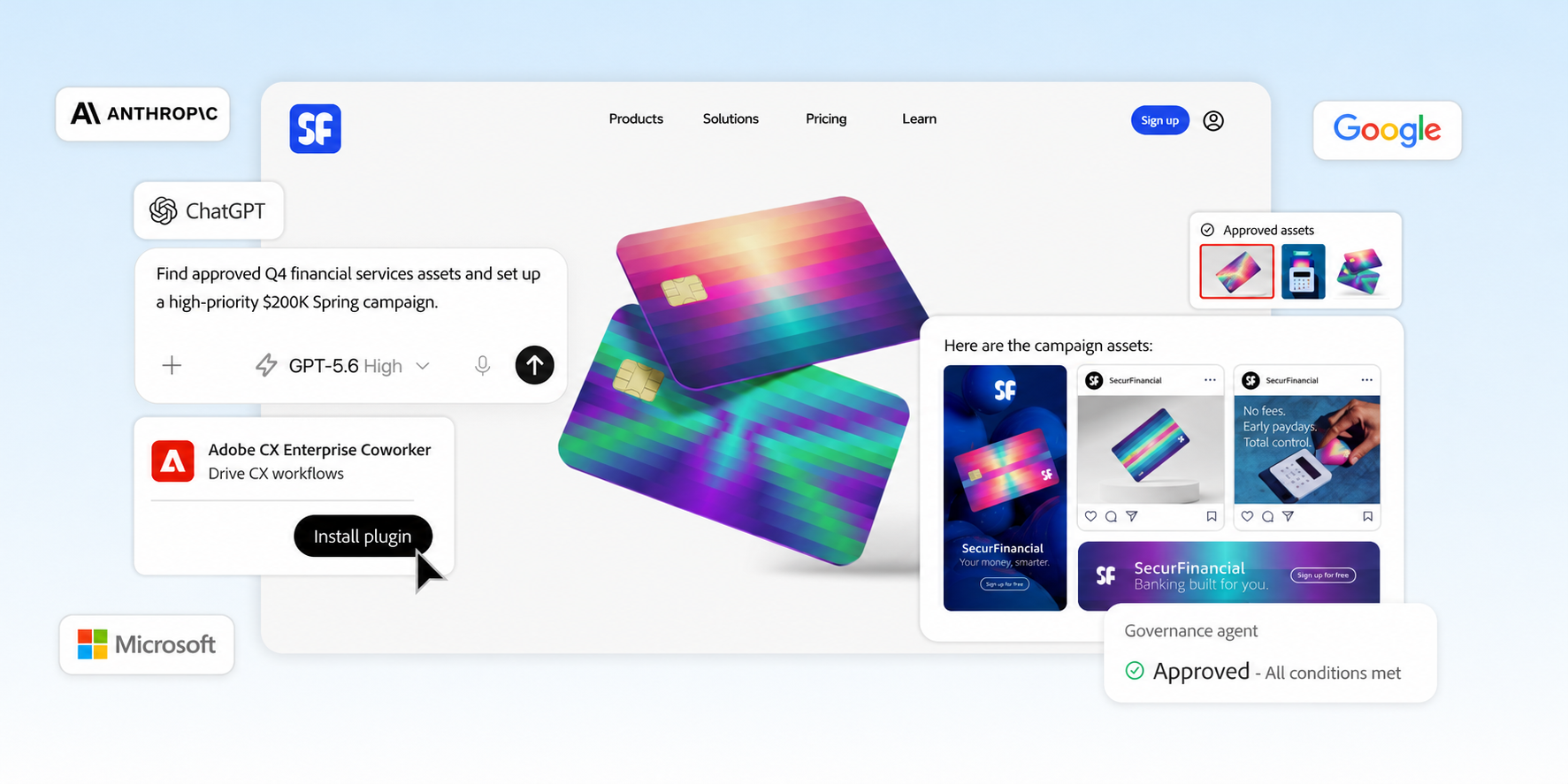
On 4 November Adobe made CX Enterprise Coworker available inside ChatGPT (as a plugin), Claude, Gemini for business, Microsoft Copilot and Databricks Genie. Amazon Quick, IBM and Snowflake are expected soon.
Adobe describes it as an agent that analyses campaign performance, forecasts audiences, improves customer journeys and helps plan the work, under human oversight. It connects to systems including Amazon Ads, Meta campaigns and Snowflake, and Adobe says it works with more than 20,000 brands.
Why it matters
Plenty of marketers spend part of their working day in one of these assistants. A brand manager who has never learnt Adobe’s menus can type “why did October’s retargeting campaign underperform?” into Claude and get the answer from the system that ran the campaign.
Our take
Salesforce announced apps for ChatGPT a year ago. I expect it and the rest of the big marketing platforms to follow Adobe into all five assistants within a year.
The catch is the data in your own account. If it holds three versions of last quarter’s audience, the agent will pick one and report on it as if it were the only one.
Other notable developments
- OpenAI’s image model learns to animate. Images 2.6 arrived on 4 November in ChatGPT and Codex. It can turn a prompt or an image into a GIF and save reference images of people, pets and characters. Developers get two new models, Flare for speed and Sunburst for detail, with markup-guided edits and SVG output. OpenAI says generation is 50% faster.
- Anthropic’s growth slows to 47% a quarter, from a much bigger base. Its amended IPO filing on 2 November shows third-quarter revenue of $17.0 billion, up from $11.6 billion in the second quarter, and $33.2 billion for the first nine months. It returned to a small operating loss in the quarter and disclosed about $895 billion of commitments, substantially all for compute and infrastructure.
- Publicis completes its LiveRamp deal. The acquisition closed on 2 November, confirmed in LiveRamp’s filing. Publicis is combining LiveRamp’s data collaboration platform with Epsilon’s identity business and promises clients “zero platform lock-in”.
- The CMA investigates Meta’s commercial terms. The UK regulator opened a case on 30 October into terms that could let Meta collect content from businesses’ websites for its own products, including AI, without giving them a choice. Meta has paused the rollout, and the CMA says it has made no decision on whether the law was broken.
New tool spotlight
Gemini Omni 1.2 Flash: 15-second video built to keep the product on-brand
Google released Gemini Omni 1.2 Flash on 5 November. It makes native video clips of three to 15 seconds, up from 10, and Google says faces, garments and brand colours now stay consistent across camera angles. You can swap a product, a background or the lighting turn by turn without starting again, then upscale to 1080p or 4K.
It is in the Gemini API, Google Vids, Flow and Google Ads, at $0.07 a second for 720p, 30% less than the previous version. Fifteen seconds covers a full pre-roll spot, and because it sits inside Google Ads, the person buying the media can make the variants too. I’d start with an existing product film and ask it for the cut-downs.
One thing to read
Scott Brinker on rebuilding your website for people and their assistants
Scott Brinker’s 4 November essay argues that AI assistants make your website more important. Agents need an authoritative source to read and services they can call, while people still visit to see the product and deal with the business directly.
His proposal is a site with two faces, one adaptive for people and one structured for agents, fed by a single “brand context model” of your content, assets and rules. It was written with Knotch, which sells into this market. Read it for the architecture, and then check whether a customer and their assistant get the same price and product facts from your site today.
Weekly hot take
By next Christmas, the big brands will list AI in the credits they publish for their ads, alongside the agency and the director, and journalists will start asking the ones that don’t why not.
One final thought
If you’ve spotted a Christmas ad this year that used AI well, or one you’re not sure about, send it my way. And if I’ve missed something you think mattered this week, let me know.
Andy Parton
Founder, Destreza