
This week
The interesting question this week is where AI meets the real world. OpenAI wants an agent to carry a task across your apps and files. Google is making the use of AI in advertising more visible to the people seeing it. YouGov is pairing simulated consumers with actual respondents. Each announcement puts a different kind of connection under scrutiny: between tools, between an ad and its production history, and between a convincing answer and a real customer. Welcome to your weekly cut of Marketing x AI news.
Key stories
ChatGPT Work makes the whole assignment the unit of competition
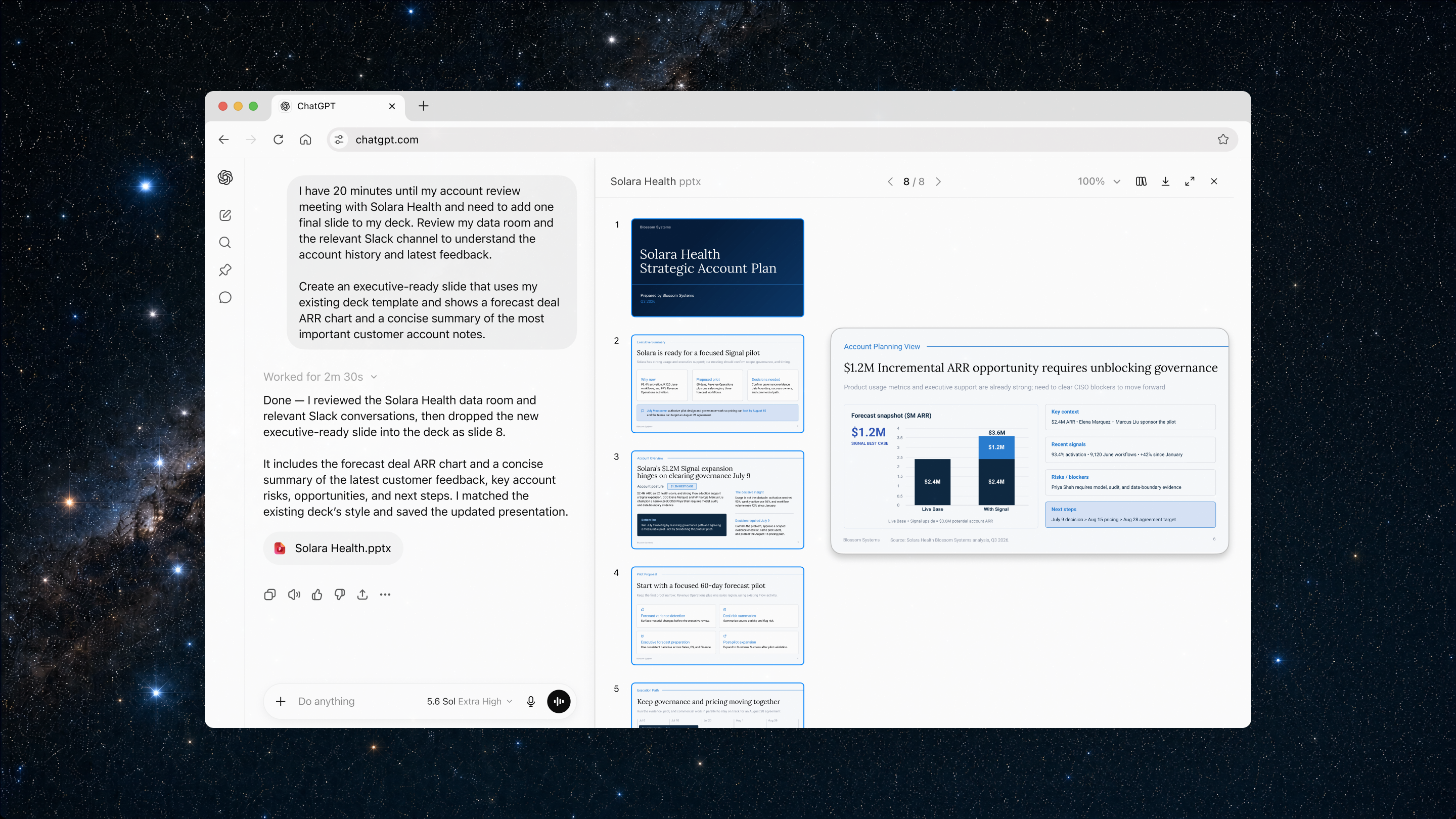
What's the story OpenAI introduced ChatGPT Work on Thursday: an agent designed to gather material from connected apps and files, work through a substantial assignment and produce usable documents, spreadsheets, presentations or web apps. Codex technology sits inside it. Users can follow progress, redirect the work and approve important actions while a task unfolds.
The launch arrived with general availability of GPT-5.6, following its limited preview. Sol is the flagship, Terra the balanced option and Luna the cheaper model. OpenAI says the family improves computer use and design judgement, including inspecting and refining the rendered result. Its new ultra setting coordinates multiple agents on parallel workstreams.
For marketing, the proposition is an assignment that survives several changes of format: customer research becomes a brief, the brief becomes assets, and those assets become market variants. OpenAI presents that sequence as a supported workflow. It is an ambitious claim about continuity, not simply another way to generate a headline.
Why it matters The commercial unit to evaluate is the completed assignment. A cheap answer becomes expensive when someone has to rebuild the spreadsheet, chase its sources and fix the deck before a meeting. Equally, a slower agent earns its keep if it preserves the meaning of the research through all three outputs. Compare that total workload with the current process, including review time.
This also changes the brief for an agency considering which AI products belong in its core toolkit. The trial needs a familiar assignment with known awkward edges: contradictory research, an obsolete template, a client correction halfway through. Polished work produced from tidy inputs tells you much less about the cost of handing over a real job. Access is unusually broad on desktop: OpenAI says the updated app brings Chat, Work and Codex to every plan, including Free, on both Mac and Windows.
Our take Give the agent a commercial decision to support. If the assignment is a presentation for a new offer, the deck needs to explain why customers would choose it and agree with the numbers in the business case, however convincingly the pages are designed. A functioning site raises the same question about the offer behind it.
The passage from research to those materials is a sensible place to test the product: ask it to assemble and check the work, then have the people responsible for the decision examine what survived each change of format. Did an inconvenient finding disappear when the brief became a deck? That is a failure worth finding, because the finished presentation may otherwise make the weak argument harder to spot.
Google adds an account of how the ad was made
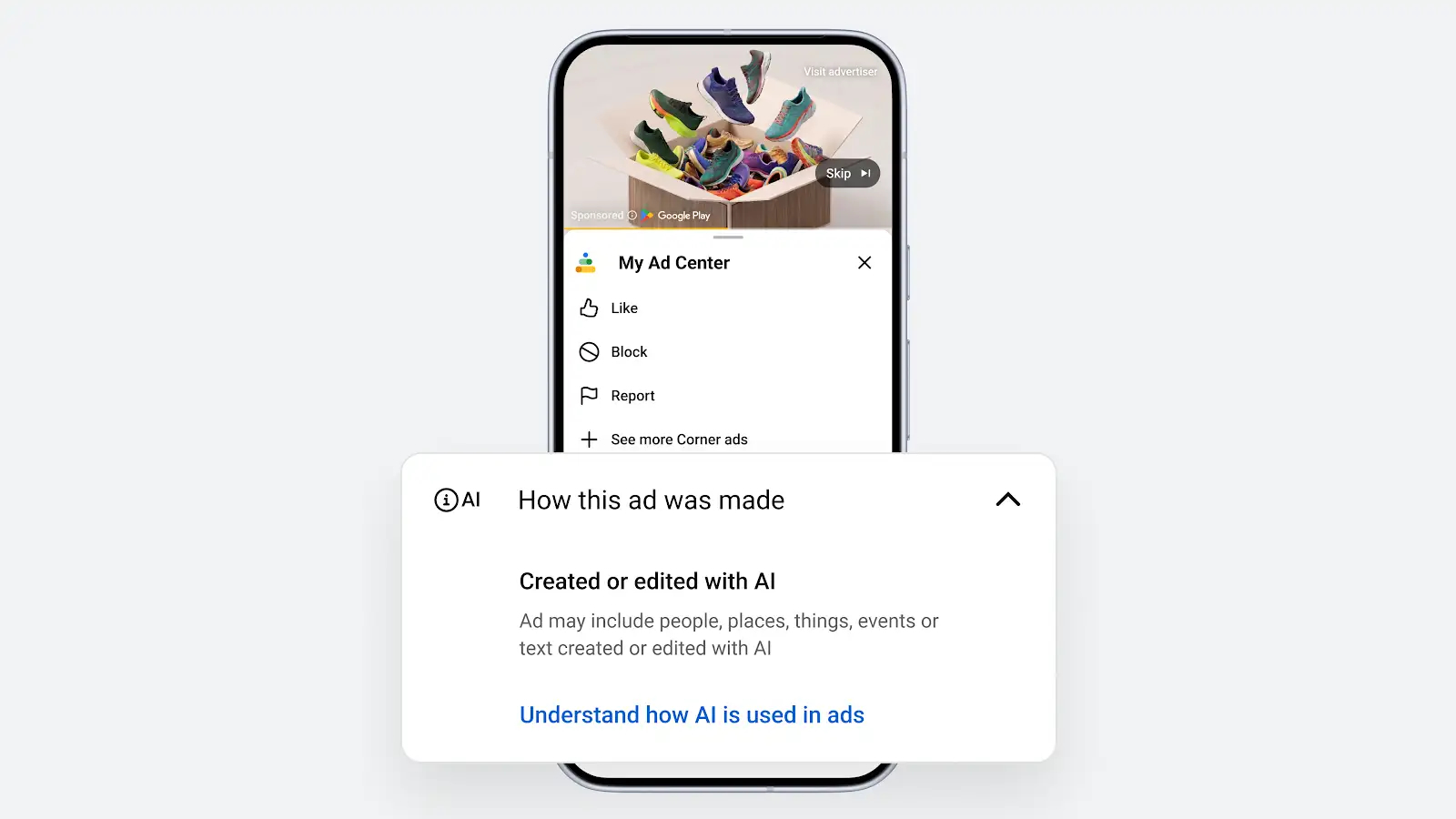
What's the story Google is adding a How this ad was made section to My Ad Center globally, available through the three-dot menu or information icon on ads across Search, YouTube and Discover. It tells people whether an ad was created or edited with AI.
Production determines how the disclosure gets there. Google says it will add it automatically when advertisers use its own generative AI advertising tools; for ads made elsewhere, a new control lets advertisers indicate AI use themselves. A label may also appear on the ad itself depending on local requirements. There is no universal visible badge in this announcement.
Google says its prohibition on misleading and deceptive advertising applies whether AI was involved or not, which leaves two separate questions for the viewer: how the image was made and whether its promise is true.
Why it matters An agency can no longer leave production history entirely with the studio. If a buying team receives an image after several suppliers have edited it, asking whether AI was used is too loose a question to give the person making the disclosure a reliable account of what changed. Record which elements were generated or altered, and which real product details were preserved. For a UK team adapting creative across markets, that information should travel with the asset, rather than sit in an email the next team never sees.
The customer-facing label comes at the end of those production decisions. Google has already tested the principle in a narrower context: it introduced disclosure requirements for synthetic or digitally altered election advertising in 2023.
Our take Start the creative review with the promise. A fantastical background asks the audience to suspend disbelief; a fabricated product demonstration can ask them to believe the product does something it cannot do, even if both executions carry the same AI label. Those deserve different conversations about creative quality.
The review needs to establish what the customer receives and whose endorsement is being shown before the team makes the production history intelligible. That gives disclosure a clear purpose at the point of upload, without turning every review into a general debate about whether audiences like AI. If the idea depends on a misleading impression of the product, send it back for revision before worrying about the label.
YouGov gives AI twins an appointment with real respondents

What's the story YouGov launched Parallax on Wednesday, combining simulated responses from AI twins with survey validation by real people. The twins are mapped to individual panel members using their data, rather than built solely around broad demographic descriptions. The enterprise product is available now, with a public demonstration alongside it.
Clients can validate the full question set or focus on selected questions. They can return to people whose twins were involved, use a fresh general population sample or select a target audience. Sample sizes and validation depth are configurable. YouGov says some surveys can return results in 30 minutes, with longer turnaround for more customised work.
That is a proposition for connecting speed with evidence. It also places a consequential choice in the research buyer's hands: how much of the simulated result to test against people, and which parts deserve that test.
Why it matters A team exploring a new offer could use simulation to surface competing explanations and choose the next question, then spend its human research budget on the uncertainty that changes the decision instead of quietly promoting the simulation into a final answer. That is a better brief than asking a simulated audience to endorse a preferred concept.
The selection of what gets validated is therefore central. If a team checks only the reassuring answers, a human layer gives the project the appearance of rigour without challenging its conclusion. The awkward or commercially decisive finding deserves attention first, especially where a segment is small or the proposition unfamiliar. YouGov itself draws a clear boundary around the launch: Parallax is for custom and ad hoc research and cannot replace tracking studies.
Our take Keep the disagreement between the twin and the person. It gives the research buyer something to investigate; averaging it away, or treating the human result as an inconvenience, discards precisely the evidence the validation was commissioned to supply.
In the final presentation, show which hypothesis came from simulation and whether it survived the survey, then connect that finding to the decision about where the business should spend its money. The result may be less neat. It is also easier for someone outside the project to challenge a recommendation when they can see how the evidence changed it.
Use fast responses to explore possible questions. For an expensive commitment, let the disagreement determine where to invest in further human research before asking the business to rely on the conclusion.
Other notable developments
- Customers are taking service questions to third-party AI tools. Gartner’s Wednesday release reports that customers are roughly three times more likely to use third-party generative-AI tools than company chatbots during service interactions. The survey covered 3,566 B2B and B2C customers in February and March. It describes reported channel use, distinct from the release’s separate survey of service leaders and financial returns.
- Sport Clips puts local marketing agents to work. SOCi says the haircut franchise has deployed more than 3,400 agents across nearly 1,800 locations, handling reviews and local search with owner oversight. The announcement reports more than 7,000 monthly customer reviews. The volume gives the agents a concrete workload, but customers receiving accurate, relevant responses is a stronger measure of success than the number of agents in the organisation chart.
- Publicis puts a price on the UK skills gap. Research announced by Publicis Media UK models £10.9bn a year in productivity value at stake as advertising and marketing skills fall behind changing roles. Kingston University London conducted the underlying economic modelling. Treat that as a modelled opportunity, not money observed leaving company accounts. For a training brief, connect the skill to the work: asking better questions and supplying business context should help people judge when to intervene.
- Bud's team joins Figma; users have a migration deadline. Bud announced on Tuesday that its team is joining Figma. It says Bud and Orchids services remain active until 18 July; hosted projects must then live elsewhere. Users are advised to download their work or save it to GitHub. For anyone building campaign tools on a young platform, exportability belongs in the initial buying decision. A promising product and a durable home for the work are separate considerations.
New tool spotlight
Claude's reflection dashboard: inspect the habit, not just the output
Anthropic's new reflection dashboard summarises the topics, patterns and kinds of tasks in your Claude chats. It is in Settings on web and desktop, in beta for Free, Pro and Max users with memory enabled. Views cover one, three, six or twelve months; Cowork conversations are coming later.
Compare the tasks appearing most often with the skills you want to develop: repeatedly asking for a first draft and repeatedly asking for criticism are different working habits, even when both produce a better document. The dashboard offers a starting point for that discussion, not an objective score of your ability. It excludes incognito chats and underlying files from connected tools. Anthropic also says a view of actual time spent is coming soon, so the launch should not be mistaken for a complete productivity ledger.
One thing to read
A faster version of a bad system is still a bad system
ExchangeWire's written account of its conversation with ISBA's Laura Wade puts a commercial question beside this week's product launches: Wade and interviewer John Still discuss sustainability and the risk that AI speeds up advertising's existing weaknesses.
The argument deserves attention because efficiency needs a chosen destination. Making a wasteful activity cheaper can make it easier to keep doing. Before celebrating faster production or more automated buying, ask which part of the system deserves to survive at all. That is a strategic question, not an argument against the technology. Read the written summary for a perspective that connects responsible media with the quality of commercial decisions, rather than treating it as an additional message to put into the campaign.
One final thought
If something in this week's issue sparked a thought, challenged an assumption, or made you want to argue the other side, I'd love to hear it. Just hit reply.
Andy Parton writes about how AI changes the work of building brands, the quality of ideas and the evidence behind marketing decisions. More from Andy.