This week
Google is testing advertising inside AI answers and planning a shopping cart, Publicis has agreed to buy a major identity platform, and WPP has put an outcome-based fee at the centre of its relationship with JLR. Each moves a different part of the marketing bargain: what customers see, how data is matched and what an agency gets paid for. Welcome to your weekly cut of Marketing x AI news.
Key stories
Google tests ads in AI answers and announces a Universal Cart
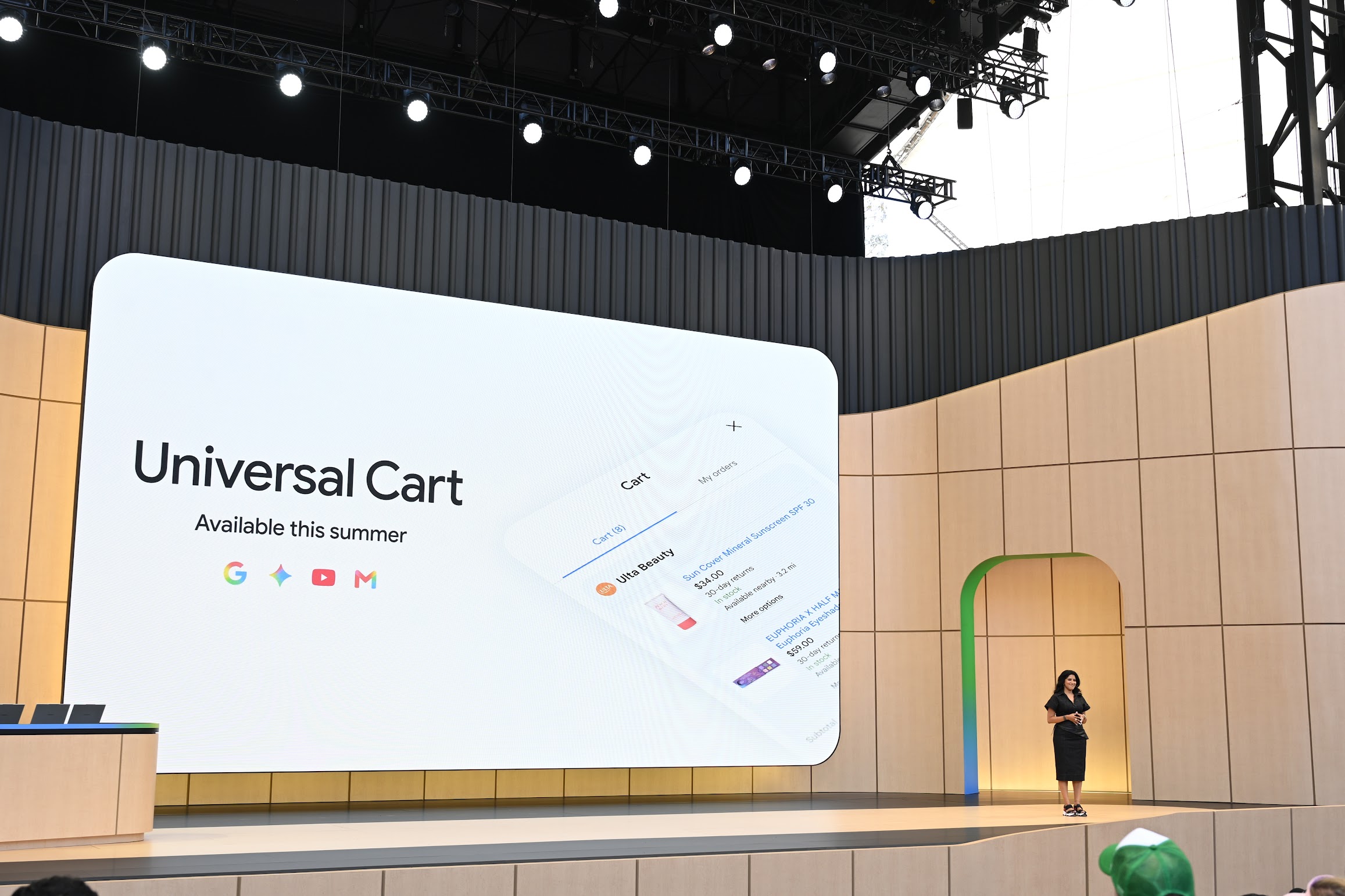
What's the story On Tuesday at I/O, Google called its redesigned search box "the biggest upgrade to our Search box in over 25 years" and moved AI Mode onto Gemini 3.5 Flash. Sundar Pichai's keynote post put the figures on the table: "AI Overviews now has over 2.5 billion monthly active users", and AI Mode, "in just a year", has "already surpassed 1 billion monthly active users". Google's AI Mode data for the US says "the average AI Mode search is triple the length of a traditional Search query", with "image searches growing over 40% month-over-month". A Universal Cart, "your new hub for shopping on Google", comes to Search and the Gemini app in the US this summer, with Nike, Target, Walmart and Wayfair among the retailers; Google says checkout on its Universal Commerce Protocol expands to Canada and Australia "in the coming months and later to the U.K.".
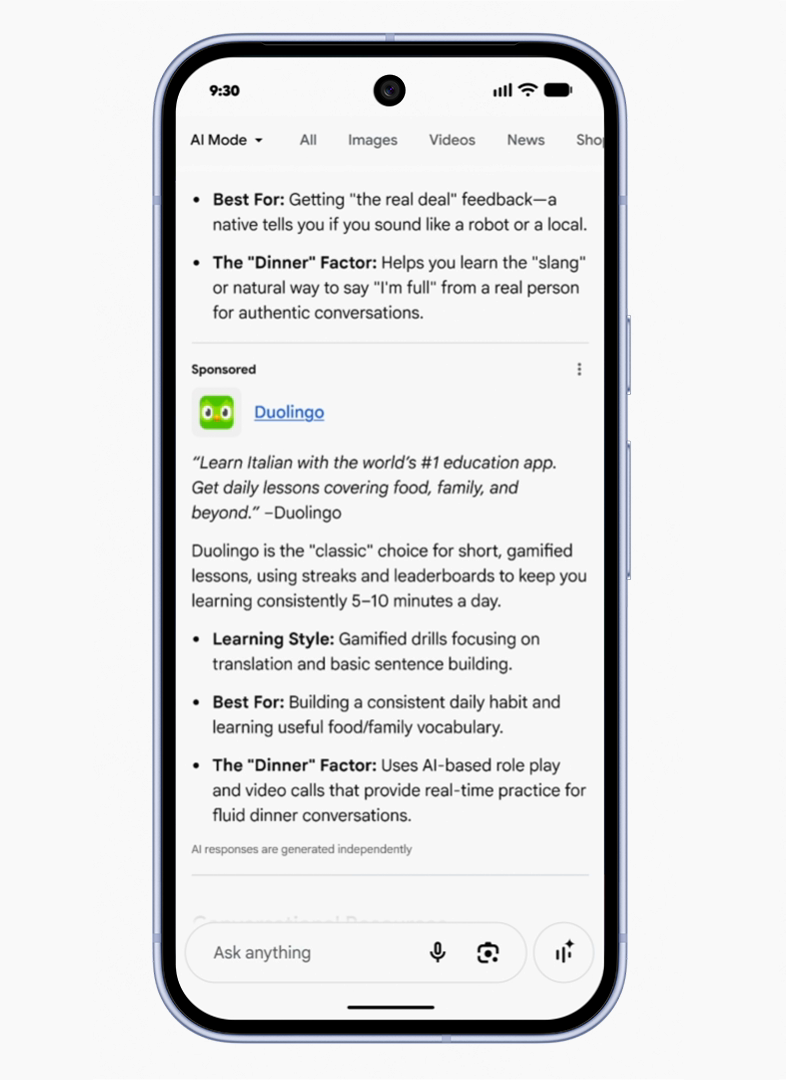
On Wednesday, at Google Marketing Live, came the ads: Conversational Discovery ads, in which "your ad answers a person's specific question" with creative Gemini tailors to it, and Highlighted Answers, sponsored results inside AI Mode's recommendation lists, both in testing, with AI-powered Shopping ads and a Business Agent for Leads to follow; all of them, Google says, "clearly labeled as 'Sponsored'".
Why it matters The unit of search advertising is moving from a keyword to a question, and the answer is written by Google's model with your creative beside it. The cart is the other half: in Google’s proposed flow, a shopper could fill a Universal Cart in Gemini and pay with Google Pay without visiting your site. The measurement relationship deserves attention before launch. On the organic side Google says there is no trick: its guide to optimising for generative AI features, reported on 15 May, says "optimizing for generative AI search is optimizing for the search experience, and thus still SEO", in Search Engine Journal's quotation of it.
Our take A conversational ad has to answer a specific question. The first decision is which questions you can afford to let Gemini answer. The pages that win that exchange already carry the answer, the compatibility, the sizing, the delivery window, the returns, as sentences rather than a spec table, because Google's model "evaluates and synthesizes information about a product or service" and shows that context next to your creative. A page written for the retailer's buyer rather than the shopper loses, so rewrite the product pages where a question decides the sale before any money goes into Highlighted Answers. The Sponsored label carries the rest of it, because an ad that answers the question is only as trusted as the label on it. Google's "75% of people report making faster, more confident decisions" rests, by its own footnote, on a Google-commissioned Ipsos survey of 13,189 shoppers who already use AI Overviews or AI Mode to shop, the population most likely to say so.
Publicis agrees to buy LiveRamp at $38.50 a share, and Omnicom pulls its exit forward
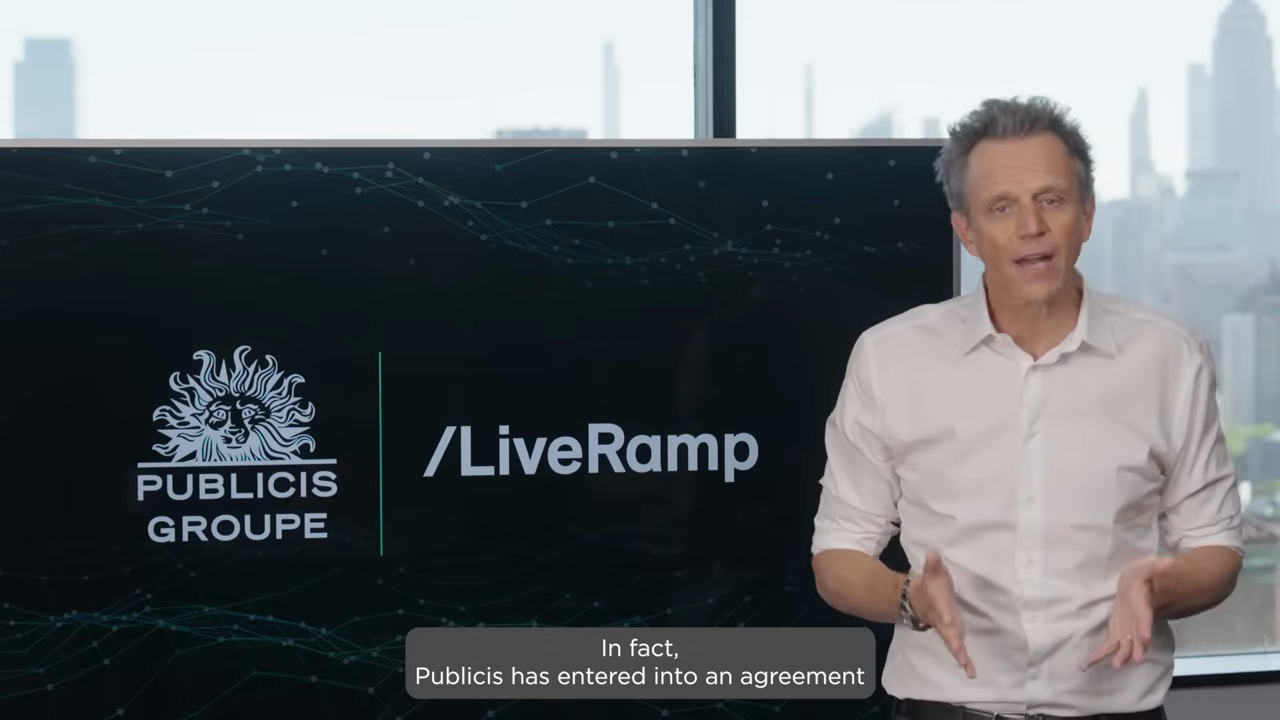
What's the story On Sunday Publicis Groupe agreed to buy LiveRamp for $38.50 a share in cash, an enterprise value of $2.167bn and an equity value of $2.546bn, a 29.8% premium to the 15 May close, closing expected before year-end, subject to regulatory and shareholder approvals and other conditions. LiveRamp connects "over 25,000 publisher domains and 500+ technology and data partners", and much of the industry's clean-room matching runs on it. Arthur Sadoun's reasoning is agents: "By building the future of data co-creation, we're empowering our clients to generate new, exclusive and proprietary data, to build the smartest, most differentiated AI agents on top of the leading LLMs." The release also says that "No current or prospective customer will be prohibited from accessing, or restricted in using, its services." In trading on Monday LiveRamp's shares rose 27%, per GuruFocus and TIKR, and Publicis's 4.2% in Paris, per Investing.com; all three tie the move to the announcement.
Omnicom did not wait to test that. Digiday reported on Wednesday that John Wren, at J.P. Morgan's technology and media conference on Tuesday, said Omnicom had planned to run its LiveRamp contract to the first quarter of 2028; now, in his words, "I moved that drop dead date yesterday a year from now when we'll be completely separated, even if we have to invest a little money to honor our contract for the balance of the year." Clients move to Real ID, the identity system built in-house by Acxiom, which came with IPG.
Why it matters The identity layer brands, retailers and rival agencies use for audience matching and retail-media measurement would sit inside one holding company if the deal closes, and Omnicom says it will not rely on it. The neutrality clause covers access. Omnicom's move says the question is trust: a competitor's data spine is a hard thing to put a client's first-party data through. Every brand matched through LiveRamp at a non-Publicis agency, and every retailer whose media network sells on that match, has the question to answer before the deal closes.
Our take Ask your agency which identity graph your first-party data is matched on, who owns it after this deal and what the contract says about moving it. "Neutral" in a press release is a licence term, and the clean-room match your retail-media measurement rests on is what is at stake. Whatever a change of graph does to your match rate, it does to every retail-media report that rests on that match, so a dated matched-audience count on the current graph is the only baseline worth having when the new one arrives. Omnicom took a day to decide; brands matching through LiveRamp at its agencies now have that migration on a clock they did not set.
WPP and JLR put an outcome-based fee at the centre of their global partnership
What's the story WPP announced a global partnership with JLR on Wednesday, covering Range Rover, Defender, Discovery and Jaguar. A co-located team drawn from both businesses will bring creative, media, production, customer experience and strategic advice together, supported by WPP Open. The commercial arrangement links WPP's remuneration to outcomes and JLR's growth.
That is the consequential part of the announcement. It describes a different basis for the relationship, but publishes neither the fee formula nor the measures that determine payment. There is no result to judge yet. A client and an agency have agreed to share a growth ambition; the release does not tell another buyer how much risk either side has taken on.
Why it matters As production becomes quicker, a fee calculated from the hours required to make the work becomes harder to defend on its own. A brand still needs someone to decide which work deserves making, and whether the money spent on it produced a useful result. Those decisions do not become easier because a first draft arrives sooner.
An outcome fee makes the definition of success part of the commercial bargain. That could give both parties a reason to improve the whole customer experience. It could also reward the easiest result to attribute while starving work whose contribution takes longer to see. The contract has to distinguish between the two; putting the word growth in the announcement cannot do that job.
Our take The useful question for an agency review is what you want to buy more of when execution costs fall. It might be stronger ideas, more work in neglected markets or a better service around the product. Agree that before discussing the share of a saving. Otherwise, the negotiation can end with a cheaper version of the same plan and no view on whether that plan was worth funding.
I would want the proposed outcome measure tested against an awkward quarter. What happens if distribution improves, prices change or supply runs short? Which contribution belongs to the agency, and which sits elsewhere? WPP and JLR have made the remuneration question visible. The unpublished detail is precisely where another buyer should start asking questions.
Other notable developments
- The 2 August duty to disclose qualifying deepfakes gets its tools and draft guidance. On Tuesday OpenAI said it is a C2PA Conforming Generator Product and is adding Google DeepMind's SynthID watermark to its images. It is "previewing a public verification tool" at openai.com/verify for "whether an uploaded image was generated on ChatGPT, the OpenAI API, or Codex". Google brought SynthID verification to Search that day. The Commission's draft guidelines on Article 50 are out for consultation until 3 June; Pinsent Masons notes that, for evidently artistic or fictional work, disclosure may be made in a way that does not hamper its display or enjoyment.
- The FTC settles with an "Active Listening" ad service it says did not listen. On Thursday the FTC announced proposed orders requiring Cox Media Group to pay $880,000 and MindSift and 1010 Digital Works $25,000 each over a service sold as targeting ads on conversations smart devices overheard. The FTC says the service "did not, in fact, listen in on consumers' conversations or use voice data at all" and consisted of reselling "email lists obtained from other data brokers" at "a significant markup". The proposed orders, open to comment for 30 days, bar misrepresenting the service, its geographic targeting and its use of voice data and consent.
- A week after the product feeds, ChatGPT's ads admit finance brands and test a bigger unit. Marketing Brew reported on Wednesday that financial-services brands are in the ChatGPT ads pilot, with Robinhood and BestMoney ads already served to its reporters; Asad Awan, OpenAI's head of monetization: "We're expanding the pilot deliberately, with a focus on learning and getting the experience right for users." Digiday reported on Thursday an early test of a larger image, an optional call-to-action button and an e-commerce unit that pulls price and reviews; until now advertisers had one format, a headline, a short description, an image and a link.
- The ICO proposes a consent-free route for low-risk advertising in the UK. On Monday the ICO published its advice to government on regulation 6 of PECR, which "applies consent requirements regardless of the level of privacy risk involved": a first-party framework under which "advertising based on the context of the content being viewed, rather than information about a person's past online activity" and, in Lewis Silkin's reading of the report, measurement, attribution and frequency capping could run without a consent banner, while "intrusive tracking and profiling people over time and across services" stays consent-based. The ICO's caveat: "nothing has changed at this stage".
- LinkedIn limits the reach of generic AI posts. LinkedIn says generic AI posts will be less likely to reach people beyond the author’s connections and followers. Its announcement, reported by Engadget this week, targets low-effort material and automated comments at scale. AI-assisted writing with an original perspective remains permitted. This is a recommendation restriction, rather than removal of the post.
New tool spotlight
Type @Canva in Gemini and the picture comes back as an editable, on-brand design
Canva's Connected App for Google Gemini, announced on Tuesday, is "rolling out gradually to all Gemini tiers and all Canva plans in select markets in English starting May 19". Type @Canva in Gemini, ask for the design, and the result opens in Canva as editable layers connected to your Brand Kit, with Magic Layers separating a generated image into movable elements. Cameron Adams, Canva's co-founder and chief product officer: "You can only experience the true potential of AI when it's connected to your brand and your context." Run last month's most-used social briefs through @Canva and count how many come back needing no correction to colour, type or logo. This first test identifies workable recurring briefs and corrections needing a designer; check the Brand Kit before blaming the prompt.
One thing to read
Ipsos, "AI Ads Are Good Enough — And That's the Problem"
Nate Cummings and Nate Pascale of Ipsos's US Creative Excellence team, with Adam Peruta and Carrie Riby of Syracuse's Newhouse School, put 20 ads through Creative|Spark with 3,000 US consumers, 10 by people and 10 by AI, published on Monday. Only 25% of those who saw the AI ads were at least somewhat confident the ad was AI-made, and 40% of all viewers were unsure either way, which is the "good enough". Human-made ads scored 14% higher on the short-term Creative Effect Index and 17% on the long-term Equity Effect Index, and the AI ads used storytelling in 30% of cases against a 49% benchmark, the problem: "While AI can produce work that is credible and largely indistinguishable to most viewers, credible is not the same as compelling." Their hybrid: AI for the lower funnel and variations, people for the brand narrative. Read it before briefing the variations Google's new formats need.
One final thought
Another busy week in marketing x AI. If you found any of these stories particularly interesting, or you think I missed anything substantial, I'd love to hear from you.
Andy Parton writes about how AI changes the work of building brands, the quality of ideas and the evidence behind marketing decisions. More from Andy.