
This week
Snap connected campaign data to AI assistants, ChatGPT gained a reported shopping ad format, and Adobe put a much larger creative toolkit inside the conversation. The convenience is obvious. Understanding who controls the next step takes a closer look, because an advertiser asking about a campaign, a shopper browsing products and a designer making an asset each need something different from the system on the other side of the chat window.
Welcome to your weekly cut of Marketing x AI news.
Key stories
Snap opens the data door, with the buying door shut
What's the story
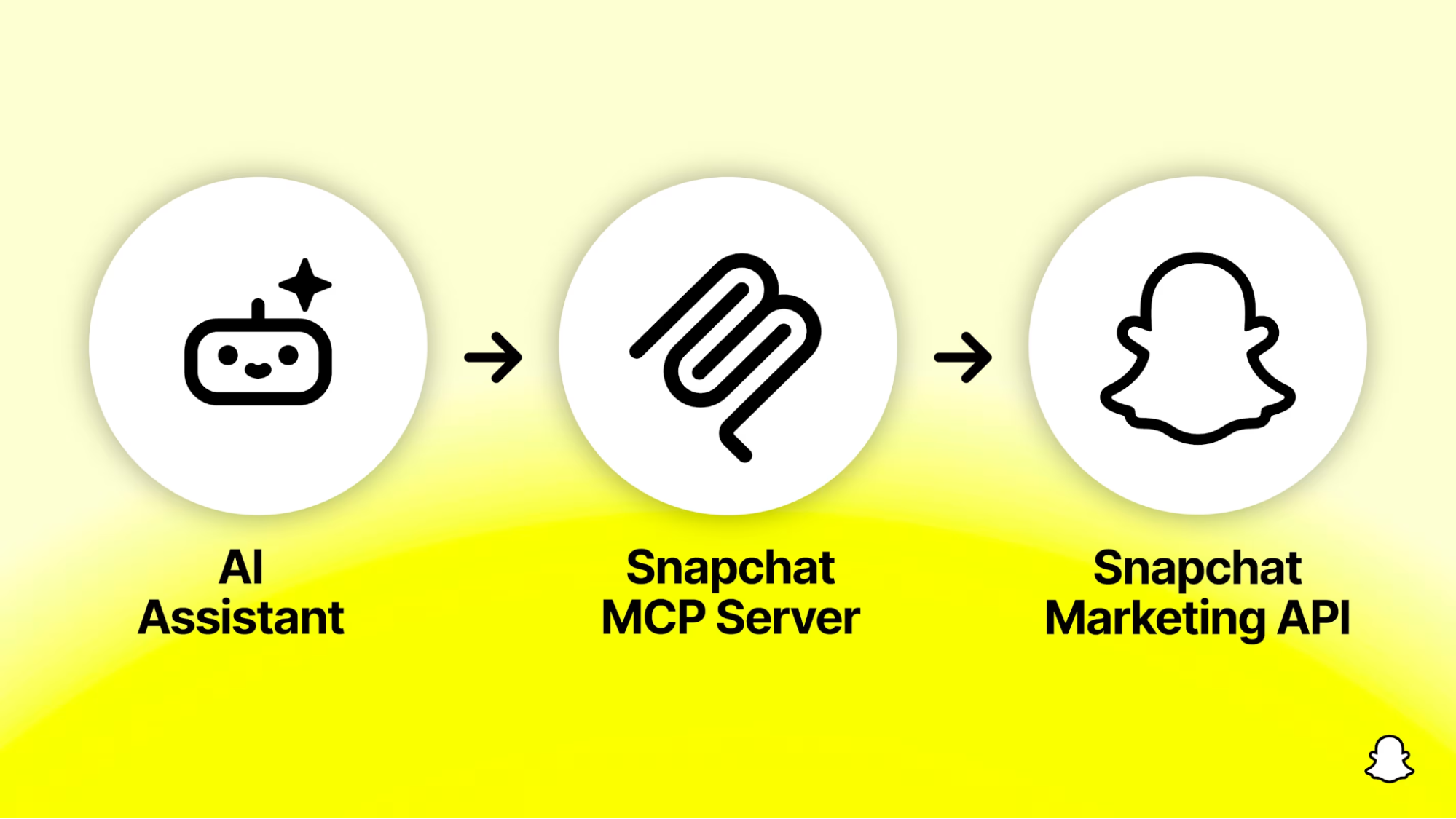
Snap launched its advertising MCP connection on Monday, letting authorised AI assistants query campaign data. MCP connects an assistant to another system; Snap's version supports tools including Claude, ChatGPT and Gemini.
The launch is read-only. It can inspect performance, but cannot change a campaign. Access starts with organisation approval, then individual authorisation. Snap shares closed Monday at $5.04, up 7.5% from Friday's $4.69; those closing prices do not establish that the connector caused the move.
Why it matters
Imagine an account manager investigating a weak week while the campaign review is still under way. The first answer may point to creative, but the next question concerns whether spend shifted towards a different audience, and asking it during the meeting is more useful than waiting for another export to arrive after everyone has left.
That is the immediate prize. The assistant still needs to explain what the report measures: a result built on platform-attributed conversions remains an attribution result when the question is asked in plain English. It has not become an incrementality study. Someone reviewing the explanation should be able to follow the denominator back to the report, especially when a persuasive account of what went wrong makes a budget change sound obvious.
Our take
Treat the first use case as a faster interrogation of a known report. A question whose answer the team can check makes it possible to inspect the assistant's assumptions before relying on its explanation of an unfamiliar result. That is useful work in its own right. A planner who can resolve an odd number during the meeting has gained something even though the campaign remains untouched; calling this launch an autonomous media buyer would promise a capability it does not provide.
The implementation should follow the same division of responsibility. Easier analysis gives more people a way to investigate, while decisions about who may see an account's data still belong with the business. Snap says an agent cannot exceed the permissions of the individual connecting it.
ChatGPT puts several products inside one ad

What's the story
Digiday reported on Thursday that OpenAI is introducing product carousels into ChatGPT advertising. Its reporter verified screenshots showing several products within a single labelled ad placement at the bottom of a conversation. The products are pulled from a retailer's feed, and the carousel currently contains products from one retailer.
That is a meaningful change in what the placement can offer. Instead of presenting one route out of the conversation, a retailer can appear with a small selection. The reporting establishes an emerging format; it does not provide evidence that carousels deliver better conversion or that shoppers prefer them.
Why it matters
The catalogue becomes part of the pitch. Consider a hypothetical shopper looking for a compact desk under a particular budget. A selection with clearly different dimensions, prices and finishes can answer the remaining question more effectively than several almost identical thumbnails. Choice is useful when the differences matter.
For a retail team, that puts attention on the feed as well as the campaign idea. Product naming, images and the consistency of attributes shape how a selection reads. The creative task includes making the range understandable at a glance. Otherwise, a carousel merely gives the shopper more versions of the same uncertainty.
There is a measurement question too. A format that attracts browsing can look successful before it sells anything. The right comparison depends on the job: helping someone find a suitable item, improving profitable sales or introducing a range. An increase in clicks cannot settle all three. Neither can the novelty of the placement.
Our take
A coherent assortment gives a retailer something useful to test. The comparison needs to follow both the product that earns the click and the basket that earns the margin, particularly if the most attractive thumbnail draws attention towards an item with poor economics. The catalogue and the commercial question are decisions the advertiser can prepare. The eventual presentation is a separate matter.
That distinction belongs in the analysis before anyone declares a format winner. A carefully prepared range is still being delivered through somebody else's interface, with choices that can affect what the shopper encounters. According to Digiday, OpenAI currently selects whether an ad uses the carousel or the single-product format.
Adobe makes the chat window a creative workbench
What's the story
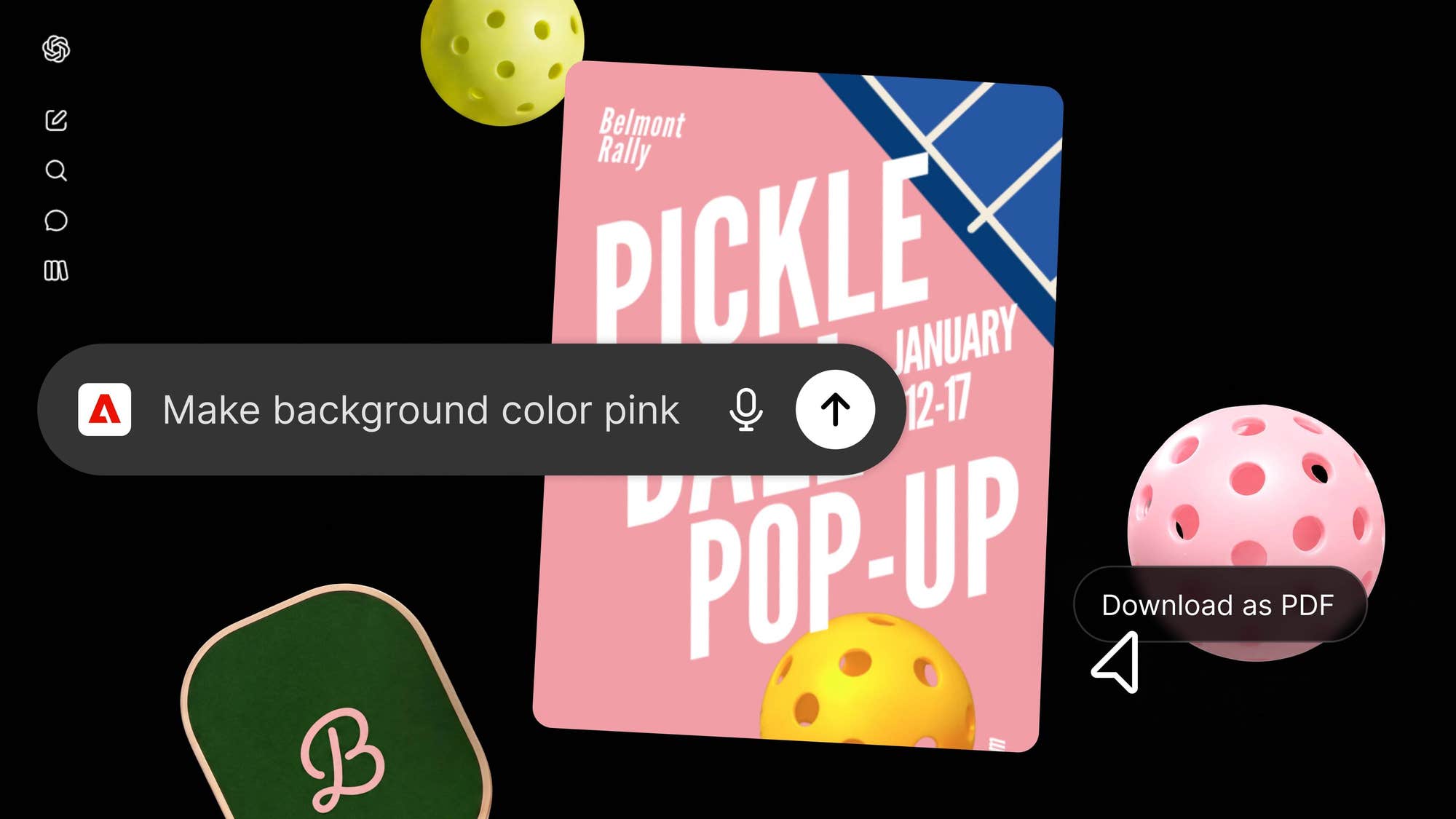
Adobe announced a unified ChatGPT plugin on Thursday, bringing more than 70 creative and document tools into ChatGPT Work and Codex, available globally on web and app.
The examples are recognisable production jobs: batch-editing photographs, making mockups, cutting video highlights and formatting PDFs from data. The plugin combines existing and additional capabilities. The practical appeal is being able to carry a brief from one job into the next without having to start the conversation again.
Why it matters
For a small marketing team, the interesting unit is the completed job. A product launch might need a mockup, a set of social variations, some video excerpts and a sales document. If more of that work can be directed from the same conversation, the team has fewer handovers to explain and fewer occasions to lose the original brief.
That makes the brief more consequential. A vague instruction can travel further when the system has more tools available. Conversely, a precise instruction can carry the important constraints from one output to the next: the product claim, the visual hierarchy, the intended audience and the purpose of each asset. The work still needs someone who can tell whether those choices survived.
Do not confuse a shorter route to an output with a stronger output. A photograph can be consistently edited and wrong for the brand. A neatly formatted PDF can make a weak argument look finished. The useful test is whether the combined workflow reduces rework while preserving the decisions that give the campaign its meaning.
Our take
A useful production trial follows one idea across its assets and then changes the brief. The second pass shows whether the revision reaches the social versions and the sales document, whether the hierarchy still makes sense, and whether the files remain easy for their next owner to use.
The work also has to survive the gap between sessions. An impressive first demonstration says little about what happens when someone returns tomorrow to pick up an unfinished asset, or when a colleague needs to continue it in the company's existing files. That makes the account setup part of the production decision. Adobe says some tools can be tried as a guest, while generative capabilities, Creative Cloud files and saving work across sessions require an Adobe account.
Other notable developments
- ChatGPT changes its everyday conversation. OpenAI updated GPT-5.6 Sol on 6 August, describing more focused responses and improved factual reliability for Plus and Pro users. GPT-5.6 Luna becomes the Free and Go default this week. OpenAI says unlimited text chats and a Think option follow next week, subject to abuse guardrails; other tool limits remain. A pleasant answer and an accurate one are different measures.
- Country-level adoption becomes easier to inspect. OpenAI's 6 August Signals update adds country-level views of how people use ChatGPT. That is a useful prompt for international marketers to examine local behaviour instead of assuming a single global pattern. It describes activity within OpenAI's product; it should not be stretched into a census of all AI use or a substitute for the team's own audience research.
- Circles joins support to personalisation. In an OpenAI customer account published on 3 August, the Singapore-founded telco technology company describes a concierge connecting account management, support and recommendations. Circles reports a 65% autonomous customer-support resolution rate through CareX. The commercial question is what happens after that resolution: a closed conversation is only a useful outcome if the customer's problem has actually gone away.
- Customers want a route to a person when AI handles service. Gartner’s Tuesday findings show 87% of respondents calling human-agent access essential when companies use generative AI. Half said AI made their interactions easier. The survey covered 3,566 B2B and B2C customers in February and March, the same research base discussed in July. This is a further finding from that study, rather than a new wave of fieldwork.
New tool spotlight
Cloudflare shows how AI assistants mention and cite a brand
Cloudflare released its AEO Visibility Dashboard in early access on Thursday. It reports citations, mentions, prominence and competitive share of voice, complementing its Agent Readiness checks. Businesses can request access from their Cloudflare dashboard; the announcement does not establish general availability for every account.
Start with a small set of questions real customers ask, and inspect the underlying answers before acting on the scores. A missing citation, a passing mention and a recommendation are different observations. Check the market, model and question being measured, then compare with referral and customer evidence. The tool can help diagnose how a brand appears. A better score alone does not establish more visits, stronger preference or additional sales.
One thing to read
The familiar challenger in fruity beer
Tristan Findlay's System1 analysis of fruity beer is a useful read on innovation that people understand quickly. System1 tested seven concepts, with Madrí Excepcional Limón earning 4.4 Stars among its sample excluding alcohol rejectors. That is a concept-test result, not a sales leaderboard.
Findlay's explanation centres on a familiar brand and an easily understood flavour. The lesson for a launch brief is to separate novelty from the effort required to understand it. A team can be bored with an idea long before its customer has encountered it. Before adding another twist to make the presentation feel new, ask which part of the proposition the shopper can grasp without an explanation.
One final thought
The chat window can remove several steps from the work. It cannot decide which of those steps contained a useful pause. Keep the pauses that improve the decision; enjoy losing the rest.
Andy Parton writes about how AI changes the work of building brands, the quality of ideas and the evidence behind marketing decisions. More from Andy.