This week
On Wednesday the Competition and Markets Authority ordered Google to let UK publishers keep their content out of AI features in search, and gave it nine months. Google spent the same day on Search Console, adding a count of how often a site appears inside AI features, and saying it will test a control that lets a site leave. Earlier in the week OpenAI's vice-president of media partnerships was asked in Marseille whether publishers would get a share of the ad money, and said not at this point. Welcome to your weekly cut of Marketing x AI news.
Key stories
Britain orders an exit from Google's AI answers, on a published clock
What's the story On Wednesday the Competition and Markets Authority imposed a conduct requirement on Google's search services in the UK. In the CMA's words, "in a world first, publishers will now have effective tools to prevent their content being used to power AI features in search, such as AI Overviews", and "Google will now also have to allow publishers to opt-out of allowing their content to be used for the 'fine-tuning' of AI models". Google is also "required to make sure that publisher content is properly attributed, using clear links, in AI-generated search results". It has nine months to implement everything, though the CMA "expects important parts of the controls to become available to publishers well before that deadline". It must also publish compliance reports "supported by key data and metrics" every six months for the first year. Sarah Cardell, the CMA's chief executive, framed it as bargaining power: "With features like AI Overviews rapidly reshaping online search, it is crucial that content publishers, including news organisations, have appropriate bargaining power over how their content is used." She said the regulator "will be announcing further action in relation to Google's search business in the coming weeks". Google said the same morning that it will test an opt-out control of its own, having promised one in March.
Why it matters A publisher that takes the exit narrows what Google's AI can say about its category. The answer then leans harder on whatever material is still there, which will include a brand's own. Media plans have treated that pool as a fixed quantity. By the time the controls are in place, the field a UK brand newsroom competes against for a citation may be a good deal thinner.
Our take Ask whoever owns your organic performance what share of your UK visibility already runs through AI Overviews. The attribution part of the requirement works in your favour whatever you do, since clear links inside the answer help anyone Google cites. The opt-out part reaches you second-hand, through the answers your customers read. Its first sign will be a change in what those answers say about your category rather than an announcement.
Search Console starts counting AI appearances, for some sites
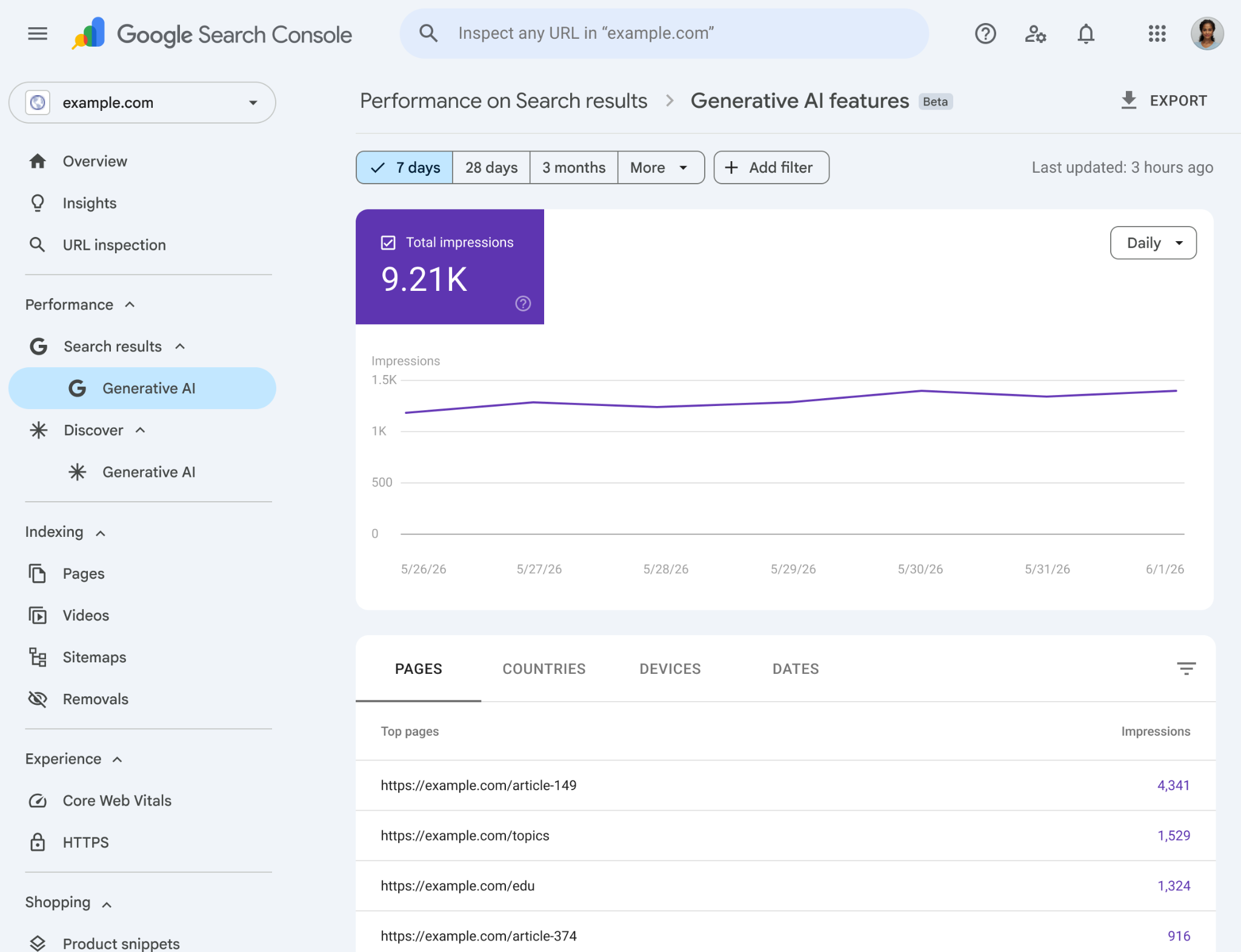
What's the story Also on Wednesday, Google added generative AI performance reports to Search Console, announced by Hillel Maoz, an engineering manager on Search, and Moshe Samet, product manager lead for Search Console. As reported by PPC Land, which quotes Google's wording throughout, the reports give site owners "a separate view dedicated to visibility from generative AI features", across five dimensions. They are impressions, pages, countries, devices and dates, with granularity from hourly to monthly. Clicks and click-through rate are not among the five. Google says it is "rolling these reports out to a subset of websites, allowing us to thoroughly test them and receive feedback before making them widely available". It is also "continuing to work with website owners to understand what insights and data would be most helpful to inform their strategies, such as adding additional metrics over time".
The same day Google said it will let a site leave those features entirely. Engadget's Igor Bonifacic reported a Search Console toggle that Google plans to test with a limited group of UK domain owners before taking it worldwide. Google's terms for it: "Sites that opt out will not receive traffic or impressions from our generative AI features", and "this control will not be used as a ranking signal for search results outside of these generative AI Search features".
Why it matters An entire vendor category grew up around a number no platform would publish. Google now publishes one, free, inside the tool an SEO team already has, for whichever sites are in the test group. It counts impressions. That is proof of citation, and pricing a citation takes the click data Google left out of the report. The toggle beside it was built for publishers, and from a brand's chair it reads the other way round, because whoever stays inside an answer inherits the space a departing publisher gives up. Renewal conversations with AI-visibility vendors change for anyone inside the group, who now has Google's own number to hold the invoice against. Google has published no timeline for widening it.
Our take The reports arrive with a membership rule Google has kept to itself, so the first question for an SEO team is whether its domains are in the test group at all. For the ones that are, impressions show how often their URLs appear. Put that series beside branded search and direct traffic for the same weeks to look for a relationship; movement together would not establish that the AI appearances caused the visits.
Cheaper to test an ad in ChatGPT; no advertising revenue share for publishers
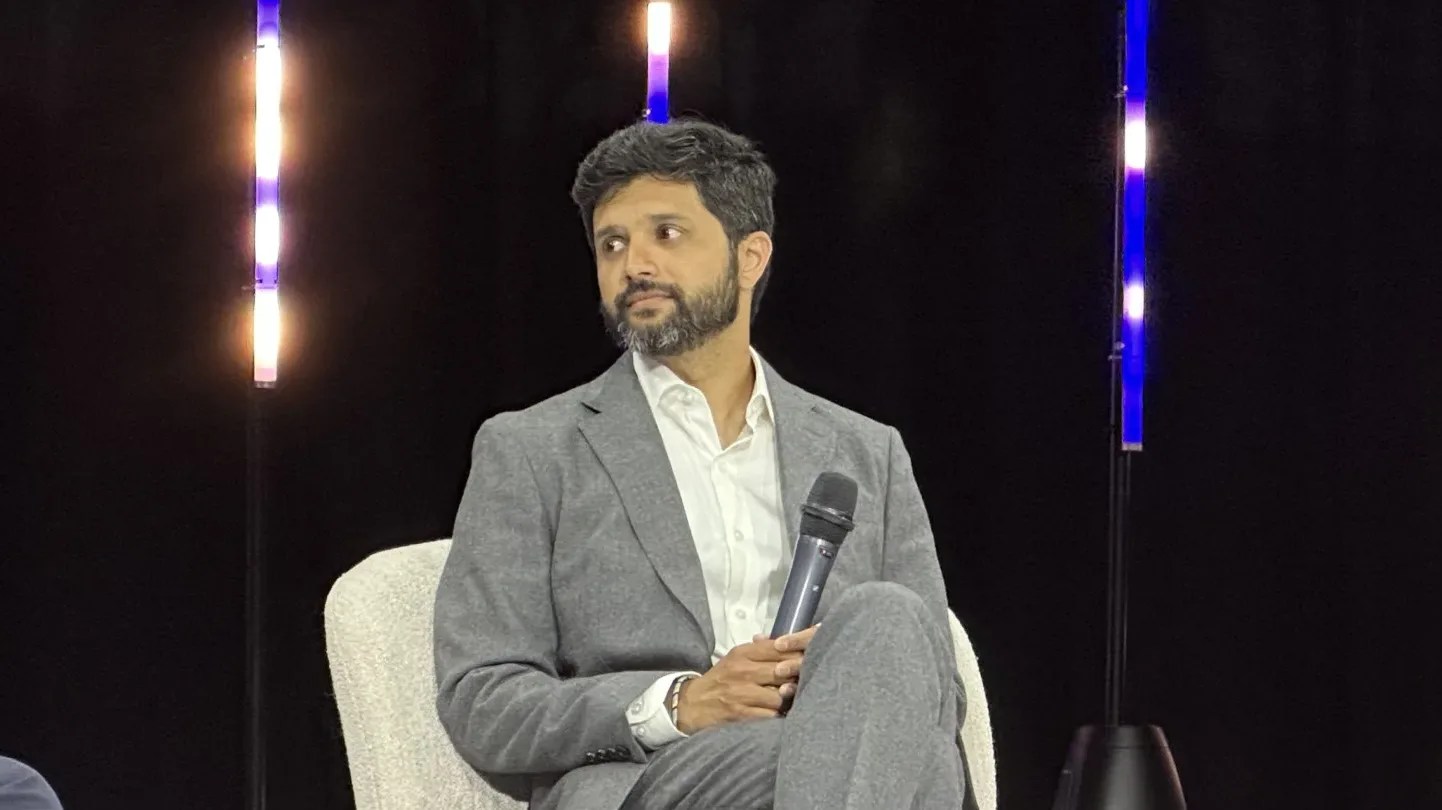
What's the story OpenAI's ads in ChatGPT moved to cost-per-action buying last week, Digiday reported on 28 May, with early access to conversion-optimised campaigns opening today for accounts that had conversions set up by Monday 1 June. Two more things about that business landed this week. On Thursday Adweek's Trishla Ostwal reported that Criteo has lowered its minimum for a ChatGPT campaign from $50,000 to $10,000 and is offering media-match deals to retail advertisers, with easier product-feed integration. Ben Kahan, head of programmatic at Brainlabs, on what that changes: "We don't have to set up all of the ads manually." And on Tuesday, at the WAN-IFRA World News Media Congress in Marseille, OpenAI's vice-president of media partnerships Varun Shetty was asked whether the company is considering a revenue share on publisher content surfaced next to ads in ChatGPT. Press Gazette's Charlotte Tobitt reports his answer: "Not at this point." He described the value to publishers in two other places instead. One is a product that "highlights trusted journalism, that cites it, attributes it, and provides an opportunity for users to click over to the original source"; the other is OpenAI technology publishers can build into their own products.
Why it matters Criteo has taken $40,000 out of the price of finding out. A ChatGPT test that most teams would have had to defend upward now clears a budget meeting. Shetty set the other term the media plan sits on. By his account the publisher's return is a product that cites the journalism and sends a reader to it, plus technology a publisher can build on.
Our take At $10,000 the case for spending rests on what you learn. That puts the brands whose customers already ask an assistant before they ask a search box at the front of the queue. Everyone else can read their results. Give a first test one measurable outcome and make it the behaviour of the traffic after it lands. That behaviour decides whether the channel belongs with search, with social, or with something the mix has not seen. Shetty's claim in Marseille was about a different flow, the traffic ChatGPT sends publishers rather than advertisers. He put it this way: "even though the overall level of traffic we're driving might be lower than publisher expectations, the quality can be higher".
Other notable developments
- Meta's business agent goes global on a token meter. TechCrunch's Ivan Mehta reported on Wednesday that the Meta Business Agent is now available globally in WhatsApp and in Instagram DMs. It "can answer customer questions, recommend products, book appointments, qualify sales leads, and reroute queries to a person if needed". Meta plans to charge for it inside some tiers of WhatsApp Business Premium; large businesses "will pay for the agent based on how many tokens they use". A platform for enterprises to build custom agents connecting to Shopify, Zendesk and Shopee is in development. Daily briefings of overnight chats are in test.
- IAB UK forecasts £18bn of AI-driven advertising by 2030, and its own members do not trust the agents. The trade body's forecast, published Tuesday, puts AI-driven advertising at "approximately £18bn by 2030, representing around 32% of total digital ad spend". Among IAB UK members, 58% are experimenting with or piloting agentic AI, 16% are scaling agentic systems and 4% consider themselves fully agent-first. On trust, 67% of members and 47% of advertisers do not trust AI agents, and 74% of advertisers believe AI summaries are reducing traffic to brand websites. IAB UK published no sample size for either survey.
- The new clause in Google's rewritten Ads terms is about automation. Search Engine Land's Anu Adegbola reported on Tuesday that terms effective 1 July say: "Customer authorizes Google and its affiliates to serve ads, including through the use of automated program features to format, select, or generate targets, ads, or destinations on Customer's behalf." The advertiser keeps the obligations: rights to everything supplied to Google Ads, and "reviewing, approving, editing, or removing campaigns and ad assets that may be generated automatically".
- A martech company bought an AI-visibility tracker. Sitecore announced on Wednesday that it has acquired Scrunch, which "provides visibility into where brand messages are appearing, missing, or misrepresented in AI-driven discovery". Sitecore's chief executive Eric Stine said "AI has changed buyer behavior forever". Scrunch's chief executive Chris Andrew put it at more length: "Control of the brand narrative is shifting, and customers are increasingly trusting AI to define brands, rather than the organizations behind those brands." Terms were not disclosed.
- Coca-Cola put media, data science and technology into one multi-market review. MediaPost's Steve McClellan reported that the company is running "an agency partner capability review process with WPP and Publicis focused on media, data science and technology involving most of our top markets around the world". North America, which went to Publicis in March 2025 at around $800m, sits outside it; Japan and Korea stay with Dentsu. COMvergence estimates Coca-Cola's 2026 media spend outside North America at roughly $1.715bn. The review begins in July and concludes in the autumn, and the company describes what it is buying as a move "from traditional media planning to...agentic tools".
New tool spotlight
Turn what an agent already worked out into a file your designer can open
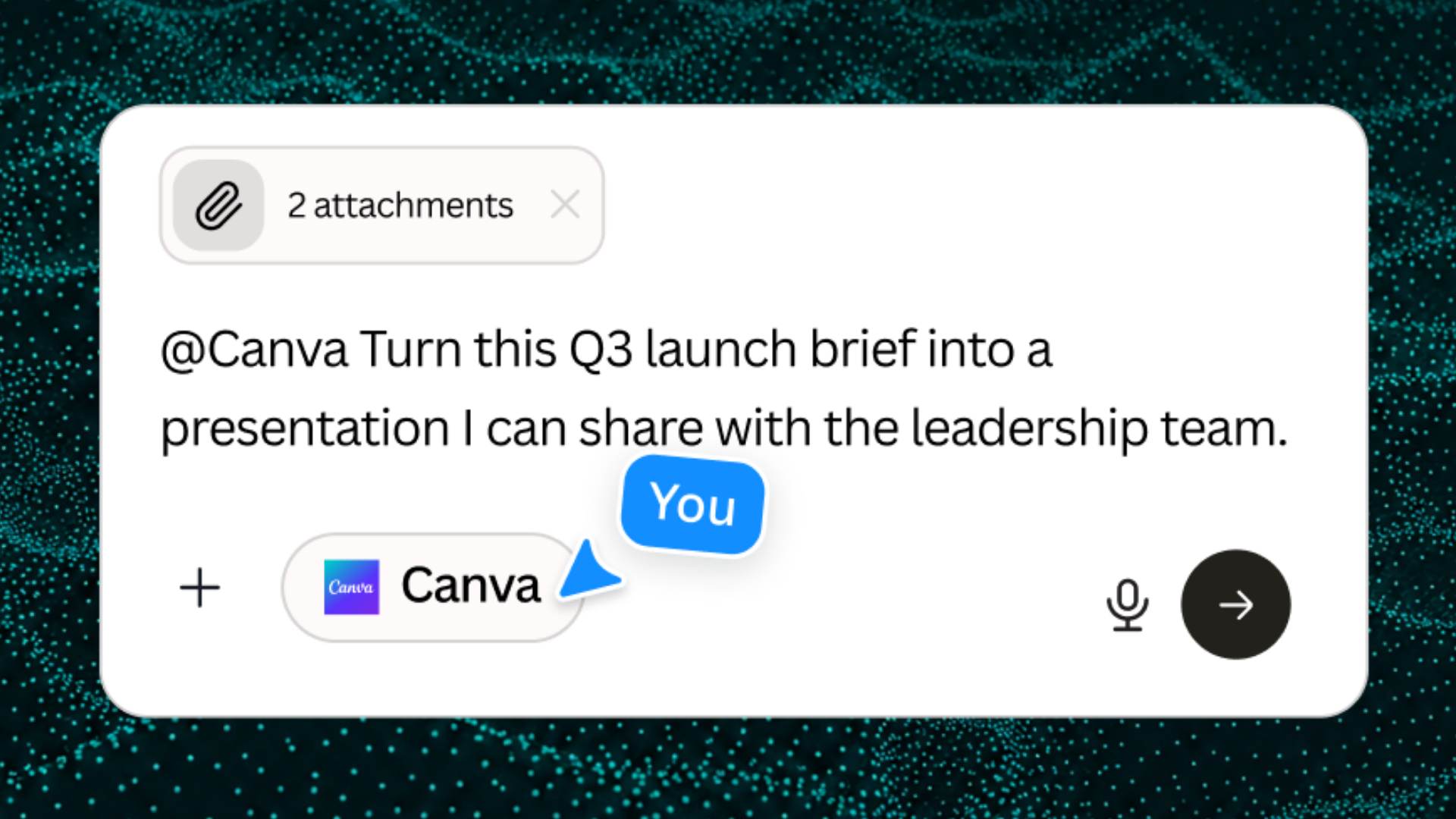
Canva has built a connector for Perplexity Computer, reported on Thursday by 9to5Mac, letting the desktop agent "autonomously turn data and prompts into editable Canva assets": a presentation, a social campaign, an infographic or a brand kit. Emily Jorgens, Perplexity's head of business development and partnerships: "Bringing it into Perplexity Computer means a growing business can design right alongside the rest of its work, turning research, data, and a rough idea into a finished presentation, video, or campaign without ever leaving the flow." An agent that hands back a picture leaves a designer rebuilding it, which is why editable is carrying the announcement. This one hands back a working file. It needs a Perplexity Pro, Max, Enterprise Pro or Enterprise Max subscription. 9to5Mac reports no price beyond that tier requirement. Point it at a deck your team built by hand last quarter and compare.
One thing to read
404 Media, "Companies Are Using Reddit to Manipulate ChatGPT and Google AI Search"
Jason Koebler's piece for 404 Media on Wednesday follows one case from start to finish. Peptide and hormone-replacement sellers post on r/Biohackers so that ChatGPT and Google's AI search pick them up. The moderators have banned new posts on both topics. Their announcement, quoted in the piece: "As AI search engines increasingly pull answers from Reddit, companies are using us for AEO. On top of that, there's been an explosion of peptide interest and AI usage flooding the sub." Read it against this week's other AI-visibility story. Sitecore acquired a company that measures this surface. Koebler documents what working it looks like at the bottom of the market. Every AI-visibility pitch sits somewhere between measuring the surface and working it, though it rarely says where. 404 Media keeps most of the piece for subscribers.
One final thought
Another busy week in marketing x AI. If you found any of these stories particularly interesting, or you think I missed anything substantial, I'd love to hear from you.
Andy Parton writes about how AI changes the work of building brands, the quality of ideas and the evidence behind marketing decisions. More from Andy.